Wednesday, August 22, 2007

Out of the Caucasus, into the Middle East

From the Georgian town Ninotsminda, I tried to hitchhike towards the main coastal city Batumi. But as hitchhiking goes, sometimes your lucky, and sometimes your not. This time, I had to wait about an hour for a car to pick me up. The guy brought me a couple of kilometres further and soon after, a second lift took me to Akhalkalaki. In this small town I walked into a cafe for khachapuri. And within 30 seconds in the cafe, I was invited by some Armenians to join their breakfast and a bottle of vodka. I talked a bit with them and did some vodka-toasting, before I headed to the marshrutka stand. I decided to continue by public transport as I was in the middle of a town and planned to travel far that day. I took the marshrutka to a place called Khertvisi, in other to see the amazingly beautifull fortress overthere. The fortress is one of the oldest remaining fortresses in Georgia and has a spectacular location. I walked around there for an hour or so and continued my journey towards Batumi. Unfortunately, the road was pretty much empty and as I didn't managed to stop a car until 3pm that afternoon, I ended up taking a marshrutka again. The marshrutka brought me to a provincial town named Akhaltsikhe, where I decided to spend the night. I found a cheap place for 5 lari ($3), dropped my luggage and had Adjarian khachapuri for diner in a small cafe with a really friendly owner.
The next day, I took a marshrutka throught the autonomous region of Adjara, until the coastal city Batumi. The road was in a pretty bad condition, which caused that the journey was long and painfull. The scenery was very nice though and it seemed like the area is inhabited by some kind of Amish people. The way of living is very primitive and when three local women entered the marshrutka, they seemed like they had never been in a car before. Stepping out of the marshrutka five hours later in Batumi, I had to get used to the solid ground again. I walked a bit and found a place to stay. Soon after I went to the city-centre and walked around. Batumi is quite a nice city, it has a subtropical climate and it is the main domestic tourist destination of the country. Full of palmtrees, beaches, expensive cars and a relaxed atmosphere, I was happy to stay there for a couple of days. I haven't done much though, I used the internet quite some time, enjoyed numerous khachapuri and coffee and did some walking. Also I was supposed to meet some girls from Tbilisi who went to Batumi for a month or so, but I haven't seen them more than 5 minutes. So as I didn't spend time with them and also because I haven't met any other travellers, I felt a bit lonely after a while.
My lonelyness was the main reason I left Batumi after two days for Turkey. I took a marshrutka to Sarpi, which is at the border and after an easy bordercrossing I was in Turkey. The border is heavily fortified, with fences all over the place and it is full of Turkish trucks. As the only form of public transport from the Turkish side is a taxi to nearby Hopa, I decided to hitchhike. After changing money, kebab and coke, I walked to the main road. Within a minute I pulled out my thumb, a big truck stopped for me and brought me to Hopa. From Hopa I had a second lift to a small town in a beautifull valley and soon after a third ride to a mid-sized town named Artvin. The guy who picked me up had been living in Nantes, France, and I communicated with him in my basic French. He gave me lots of fruit and roasted corn on the way and in Artvin he found a cheap hotel for me, which he insisted on paying. Really an amazingly nice man. In the evening I enjoyed tasty lahmacun and went to sleep early. Around midnight that evening, I woke up because of Georgian prostitutes knokking on my door. I didn't open, because I knew they were working girls as I saw them in the hotel before.
The day after I had something else disturbing my sleep at 04.30am. My room had an open window and was next to the main mosque, so I woke up because of the morning prayer call. After sleeping a bit more, I started my journey towards to Iraq. Throught a travelforum I met an Irish guy, Edward, who was going to Iraq as well and we arranged to meet in the southern Turkish city Diyarbakir. So on that day, I travelled for over 700km from Artvin to Diyarbakir in two different bussus, as I had to change in Erzurum. In the second bus, from Erzurum to Diyarbakir, we were stopped by a militairy checkpoint somewhere halfway. Appearantly, it had something to do with the PKK, as I was entering Kurdish territories. I arrived on Diyarbakir's Otogar (busstation) 30 minutes past midnight and as the only way to get to the centre was by taking an expensive taxi, I decided to sleep on a bench in the busstation. The day after, I went into the republic of Iraq, but more on Iraq later on.

Thursday, August 16, 2007

Tight-ass backpacking in Armenia

The concept of backpacking is simple: exploring the world by carrying all your stuff in a backpack. And usually, most backpackers have more time than money and therefore travel as cheap as possible. But to travel ultra-cheap, by doing things like hitchhiking, sleeping outside and following a diet consisting instant-noodles for breakfast, lunch and diner has a different meaning. My Bulgarian travelpartner Kalin gave it a name: Tight-ass backpacking. And Armenia I will remember as a country where I virtually travelled all the way this style. Read the following story and find out why.
After hitchhiking to the Armenian border from Tbilisi, we got our Armenian visas straight away for a fee of $30. But as it was late allready and getting dark, hitchhiking into the country wasn't easy. Kalin and I finally managed to get a ride to a gasstation in the middle of nowhere and, luckily, soon after a second lift to Haghpat monastery. We stayed in a small hotel next to the monastery, where we enjoyed a gorgious Armenian diner. The morning after we saw the pretty monastery and walked down towards the main road after. On the way, a priest from the monastery picked us up and brought us to the first real town: Alaverdi. In that place we bought a honeymelon for lunch and figured out what to do next. At the same time, a bus full of Dutch 'Golden-Age' tourists was stopping next to us. I went into the bus and asked the tourguide if we could join their group to whatever place they where going to. However, the guide refused us at first, but came back to us later and invited us to join the tourgroup until lake Sevan.
So, we enjoyed a nice free busride with airconditioning and free information about the area from the guide. Also we stopped in Haghartsin monastery and made it to lake Sevan that evening. Sevan is one of the highest lakes in the world, lying at 1900m above sea-level. Only downside of Sevan is, that it's a touristic place (domestic tourism) and that accomodation is expensive. So, we decided to sleep outside. We walked towards Sevan-peninsula, saw the amazing monastery overthere and dropped our backpacks in a nice piece of grass. The night was very painfull and cold though, as we were sleeping on some rocks and I only had a thin sleepingbag. But who cares....it's free.
As expected, we woke up early and walked to the main road. We hitchhiked to the capital Yerevan after, where we arrived around 10 o'clock. In Yerevan we had a long walk to the first metrostation and we saw some nasty dogs doing 'exercise' (shagging) on the sidewalk. My first impressions of Yerevan were not quite positive. The Armenian capital is very polluted and quite a boring city, there is nothing much to see and it is a big city like any other. However, I enjoyed staying in the capital a lot, because we found a very cheap place to stay. We stayed in the ghetto-area of Yerevan, in a small homestay for as little as 1250 dram (less than 3 euro). Our room had two U-shaped beds, there was no running water, a bucket-shower with cold water, free coffee and another guy staying there who spended twice in jail and had been deported from Russia for an unknown reason..... But again, who cares, it is cheap and we enjoyed our VIP-accomodation for five days in total.
The next day in Yerevan, we did some walking around and we met a British guy with whom we drunk a couple of beers in the evening. The day that followed, we woke up in our royal-suite, took a metro to the centre and went by marshrutka to Echmiadzin, a place 20km west of Yerevan. Echmiadzin is the holy-see of Armenian christianity and we saw the impressive church there. Like in Georgia, Armenians are deeply religious and this was quite visable in Echmiadzin. We didn't stayed long though and catched another marshrutka back to the capital around 5pm. Back in Yerevan we ate some cheap lahmacun and went back to our homestay. The following day we made another daytrip, we went by bus south to a church called Khor Virap. The church is beautifully situated with views on the holy Armenian mountain Ararat. It is an amazing place with gorgious views on the surrounding areas. Inside the church we met a guy holding a chicken and a knife. Kalin talked with him and the guy told us that they brought the chicken to sacrifice it. We saw the slaughtering of the chicken after and one of the women draw a cross on our foreheads with the chicken's blood (see my picture). Quite an amazing experience. On the way back, we hitched to the main road, where we bought and ate a melon. Soon after we hitchhiked back to Yerevan, together with a nice guy in a Samara.
The next day, we haven't done much. I took a bucket-shower and washed my clothes by hand. Kalin and I played lots of chess, drunk a beer and ate some kebab on the blazingly hot day. In the evening we met Yoav, an Israeli backpacker who is a friend of Kalin and who I met in Tbilisi and Kazbegi. We had diner together with Yoav and played a dice game in the night. The morning after started with lots of coffee and hanging around in our homestay. We had kebab for breakfast and walked in the city centre towards the busstop. I left Kalin and Yoav around 4pm, with a bus to Ashtarak, 30km west of Yerevan. The rest of the day I hitchhiked to Georgia. I got a ride for about 50km to a town named Talin and after half an hour waiting a second lift 10km further. The guy from my second lift felt sorry for me and insisted I took 2000 dram (6$) from him, amazing. Also, the same man arranged a third lift for me to the northern Armenian city Gyumri. On the way the driver pulled over because of a huge hailstrom. The weather completely changed and it rained hailbricks as big as rice. Finally, we made it to Gyumri and the driver brought me to the end of town, so I was able to hitchhike further. The main problem was, that it was getting dark allready and almost no cars passed by. Luckily, I got a ride from 4 funny guys and they decided to bring me all the way to the border. Around 9.30pm I crossed the shithole border Bavra into Georgia and got a ride from two big maffia-type of guys to the first real Georgian town Ninotsminda. The guys where absolute bastards: big, fat, chainsmoking guys, with kind of a gangster attitude. They were nice to me however and brought me to a cheap hotel in Ninotsminda. I payed 5 lari (3 dollar) for a bed and a beer in the hotel, which is even cheaper than the place in Yerevan. I slept early, because I intended to travel far the next day.

Thursday, August 09, 2007

Bikini's and bulletholes in obscure Abkhazia

In Kutaisi, Kalin and I had a quick breakfast in the early morning, in order to catch the bus to Zugdidi. And allthought busses in Georgia are cheap and more comfortable than the packed marshrutkas, our bus to Zugdidi was annoyingly slow, with stops in almost every village. When we made it to Zugdidi, I met an English guy named Ian, with whom I agreed to travel with to Abkhazia. I guess most of you people have never heard of the republic of Abkhazia and have no freaking idea what kind of country it is. Well, Abkhazia officially isn't an existing country, because on paper it is still part of Georgia. But the Abkhaz fought in the '90s an independance war, supported by Russia, which they more or less won. Practically, Abkhazia is now independant from Georgia and the Abkhaz have there own government, which issues different visas. Abkhazia lies northwest of Georgia and shares most of its border with Russia. For me, it was quite exciting to travel towards Abkhazia, as virtually no western tourists are going there and most people still consider it as warzone. So the minutes before crossing the border were quite nervious and I was full of curiousity of what Abkhazia would be like.
Ian and I took a taxi to the border and, after showing a Georgian border guard our papers, we hopped on a free UN-bus to the Abkhaz side of the river Inguri (which is the border). At the Abkhaz side, our names were written down in some notebook and we legally entered Abkhazia. From the border we went by marshrutka to Gali, which is the first real town in Abkhazia. Gali is quite an odd place, as most of the city is deserted and I saw almost no people on the streets. Lots of empty appartment buildings and it was pretty obvious that the majority of the population left the city during the war. A couple of kilometres outsite of Gali, we were stopped by a checkpoint of the Russian military forces. The Russian soldiers were acting like absolute assholes, abusing their power and stupid uniform by asking unimportant questions and showing us they are in charge. Luckily, they didn't hassled us too much and we managed to find a ride to the 'capital' Sokhumi soon after. An Abkhaz couple with a Lada picked us up and they drove us to Sokhumi for 200 rubles (Russian Ruble is the currency in Abkhazia, Georgian Lari is worthless). On the way, we saw a lot of UN cars and the villages on the way are mostly abandoned. Most part of the area between Sokhumi and Georgia used to be the major warzone and this was still visable, allthought with the UN presence it is quite safe nowadays. Also on the way to Sokhumi, the driver hitted a small pig, crossing the road, and allthought the Lada didn't had any problems, the pig was pretty dead after. The driver didn't bother and brought us to Sokhumi within an hour.
In the Abkhaz capital of Sokhumi we found a cheap (800 ruble) homestay at a nice family. After we dropped our luggage, we strolled a bit around the city and visited the ministery of foreign affairs in order to get our visa. Ian was at first not allowed to enter the ministery, because he was wearing shorts (they said: this is ministery, not a beach!!) but we got our Abkhaz visas the day after. When we finished our ministery visit, we continued our walking in Sokhumi, which I think has a nice atmosphere. It is full of burned Russian tourists and it feels a bit like a Latin American beach town. The climate is subtropical, the city is full of palmtrees and has some beaches, which are known as the best ones in former Soviet Union. On the other site, lots of buildings in Sokhumi are abandoned, some full of bulletholes and it still feels a bit grimm. Russian is the main spoken language, the currency is Ruble and most of the products are made in Russia. Abkhazia is kind of a Russian satelite-state.
The second day in Abkhazia started with a very heavy thunderstorm, which together with crying babies and barking dogs, kept me awake in the early morning. The rest of the morning was pretty rainy as well, but I spended the dryer afternoon visiting some churches and more strolling around the plesant city. In the evening, Ian and I had diner in a nice restaurant and after a while I was invited to drink a couple of beers with two Abkhazian guys. At first sight, they looked nice and honest. But when one of them was buying cigarettes and the other man left the table for a toilet visit, the waitress told me: 'please don't go with them, they are bad boys'. Also it was pretty strange that they weren't interested in my background at all and wanted me to join them for 'a walk on the beach'. I took the advise of the waitress serious and made up some excuse to leave them. I went back to the homestay soon after.
Next morning started with instant noodles, Georgian coffee and a long walk to the busstation. While waiting for our bus, we walked on Sokhumi's trainstation, which is one huge scrapheap. There is junk and trash all over the place and the station is one of the dodgiest places I've seen. After our wandering on the railwaylines, our bus took of for Novy Afon, a town 20km west of Sokhumi, where we arrived half an hour later. The town Novy Afon is very beautifull, with an amazing monastery and a relaxed atmosphere. But also, it is packed with hordes of redly burned Russian holidaymaker.
After the monastery, we saw some caves and spended a couple of minutes on the nice beach, before catching a marshrutka back to Sokhumi. Back at Sokhumi's busstation, we were invited for cognac and coffee with Abkhaz policemen, which was quite plesant. We talked a bit about the weird Abkhazian situation and went back to our homestay after. The fourth day in Abkhazia, I spended with a bustrip towards Gagra. But after the third breakdown of the bus, I hopped of somewhere halfway and went back to Sokhumi by marshrutka. Back in the capital, I did some more walking and had diner with Ian after.
The morning after, we intended to leave Abkhazia and walked towards the southern part of town in order to hitchhike. At first, we asked in the UN base if we could go with one of their vehicles to Inguri. Unfortunately, we weren't allowed to go with an UN car, which caused we needed to hitchhike properly. And soon, we managed to get a ride with a nice guy working for Unicef, who brought us halfway. Not long after, a second lift brought us to a deserted crossroad, not far from Gali. We catched a bus to Gali and I spended most of the busride talking with the cool busdriver. The Russian checkpoint in Gali wasn't a problem this time and quickly we were back at the Abkhaz-Georgian border. We didn't had any problems on the Abkhaz side, but totally unexpected, the Georgian side of Inguri gave us a small headache. When we thought we managed to be back in Georgia, some fucko in a family car called us over to see our passports. As the guy was sitting in a car, wearing casual clothes, I asked who he was and I demanded to see his ID after he said he is a borderguard. We showed him our passports and Abkhaz visas, but after he returned us our passports, he kept the visas. I wanted to keep the Abkhaz visa as a souvenir and had a long discussion with the guy to keep the visa. Officially, he is not allowed to take our visas and he acted, as most of the stupid borderguards, as a little baby. Childish as he is, he demanded we made a photocopy of one of the visas in Zugdidi and he promissed us to give the other visa after. With a delay of allmost three ours discussing with this dickhead, he returned us our visas and we moved on back to Kutaisi.
In Kutaisi I went back to the same homestay, where I enjoyed a wonderfull meal and a good game of chess with Ian. I slept outside that night, on the roof of the house, because the inside-temperature was blazingly hot. The next morning, I woke up at 6, had a quick breakfast and hopped on a bus to Tbilisi. When I arrived overthere around noon, I had a rendez-vous with Kalin at Khatuna's homestay and we enjoyed gorgious khachapuri for lunch. As we decided to hitchhike that day to Armenia, we left soon after and went by metro outside of the city. Our first ride brought us halfway to a small town named Marneuli. Overthere, we were invited for beer by some old tipsy Georgian guys. I found it highly amusing to watch and talk with the slightly drunken Georgians, but after about an hour we continued hitchhiking towards the Armenian border. Quickly, we got a ride from an Armenian guy in a Lada minivan to the border and in the early evening we entered the republic of Armenia.

Sunday, July 29, 2007

Impressions of Georgia: wine, Stalin and mountainscenery

On the Azeri-Georgian border, I had to wait for quite some time for the borderguards to finish their bureaucratic stuff. But while waiting, I met some nice Georgian people with whom I talked for a while. Within 5 minutes, I was busy with writing telephonenumbers of all their friends in Georgia who I should visit. Also they helped me with transport from the border, as they had a big bus full of teenagers going to 'patriot camp' and I was invited to join them. They dropped me off in the village Sighnaghi, as I asked them. Sighnaghi is a small town in the region Kakheti, in the east of Georgia. And when I arrived, I found a place to stay right away in the homestay (sleeping in someones house for little money) of an old construction worker. The same man invited me for diner and some beers in a small cafe, which I very much appreciated. The guy walked into the cafe, grabbed a big fish from the wall and smashed it on the table. Bon appetit...... The beer was nice though and it was highly amusing to watch the people in this small cafe full of semi-drunken construction workers.
Next morning, I walked a bit throught Sighnaghi. I liked the town very much, as it has a beautifull setting and some kind of Italian atmosphere. The view from Sighnaghi over the Kakhetian wine valleys was pretty amazing as well and there were some churches and lots of old buildings. Around noon I hitchhiked to Telavi, which took me allmost all day. And when I arrived in Telavi, I walked towards the homestay of an old Georgian woman. Her name is Manana and she lived by herself as both her husband and daughter died. She provided me with lots of Georgian coffee and we spended quite some time talking (in Russian off course) about her and my life. After my coffee, I went to a small park where I met a group of Georgian people, with whom I spended the rest of the evening talking and drinking. At the same time, there was a free concert in the city, it was organised by a telephone company, and it was nice to hear some Georgian music together with my beer.
When I woke up the next morning, there was a nice cup of Manana's coffee waiting for me. After I finished my coffee with macaroni for breakfast, I went to the busstation for a marshrutka to the religious site of Alaverdi. It is a huge complex with a big Georgian Orthodox Cathedral. And I found it quite fascinating to watch the intense practise of Georgian Christianity overthere. The Georgian religion is, after the Armenian, the oldest form of Christianity in the world and almost all Georgians are quite strond believers. At the Cathedral, I talked a bit with some priests and enjoyed the surrounding views, before I catched another marshrutka towards Telavi. On the way, I hopped of the marshrutka and walked towards another religious site, the monastery of Ikalto.
When I arrived at Ikalto, I met some of the people from the monastery, who invited me for Kakhetian wine and a lot of talking about Dutch football. The wine was tasty and one of the man gave me a short tour throught the pretty monastery. After, I returned to Telavi, where I watched the second concert day and spended the evening drinking and eating with another group of Georgians who invited me.
The next day, I thanked Manana and went by marshrutka to the Georgian capital Tbilisi. I got little bit sick in the marshrutka though, but when I arrived in Tbilisi I felt quite better. I met a German traveller (the first foreigner I met since Sheki) who helped me finding the cheapest homestay in the city. I stayed at Khatuna's homestay. Khatuna is a woman of about 35 years old, who lives with her small daughter Nadya and her old mother. The homestay is known as the 'Japanese place', because a lot of Japanese travellers are staying there (allthought I haven't seen any Japanese so far). I talked a bit with Khatuna and her family and went to sleep early to make sure I wouldn't be sick the next day.
My early sleeping helped, as the next day I didn't had any medical problems and could easily spend all the day sightseeing in Tbilisi. I started my walking with coffee and khachapuri (Georgian national dish, very tasty) in a small cafe. And while I was eating, I saw on the television in the cafe a news-reportage about a policeman who was shot in his car. And after I finished my lunch and walked out of the street, I saw the same car including journalists and crime investigators.The city Tbilisi I enjoyed very much, it has a charming and relaxed atmosphere and there are lots of things to see. It is full of churches, but the city feels like an European capital with an Asian way of living. In total I spended 5 days in Tbilisi and I saw a lot sights, including the third biggest church in the world (Sameba), and too many other churches. Also I spended two days with some teenagers who are living in a suburb called 'Afrika' and I was invited to view their living area full of concrete Sovietstyle appartmentblocks (and to drink quite a lot of Kazbegi-beer). Also in Tbilisi, I met two other travellers: Kalin from Bulgaria and Waldek from Poland, with whom I travelled to the mountaintown Kazbegi. We went to Kazbegi by marshrutka and I enjoyed some amazing mountainscenery on the way. The road links Tbilisi with Vladikavkaz (in Russia) and is known as the Georgian Military Highway.
In Kazbegi we found a nice homestay and we spended the rest of the day eating, drinking and talking. The next day, we hiked up to a small church on top of a mountain, with amazingly beautifull views over the Caucasus and the 5033m Mt. Kazbeg. When we made it back to Kazbegi, exhausted, we were hanging a bit around and we made our selves a diner. From Kazbegi, we shared a taxi and went to a small village on the Georgian Military Highway called Ananuri. Overthere is a very pretty fortress/church and we visited this site that afternoon. We catched a marshrutka back to Tbilisi, were we stayed for 3 more nights.
In Tbilisi, I haven't done much actually. I played a lot of pool with Kalin and we went to a 'party' in Irina's homestay (homestay with quite a lot of travellers). Also, we made a daytrip to Gori, a small city in the centre of Georgia, famous for being the birthplace of Joseph Stalin. We saw a huge statue of Stalin (the only statue of the bastard still standing) and we climbed a huge fortress in the middle of the city. And allthought Gori is quite a depressing place, were is nothing much to see besides the Stalin attraction, it was quite nice for a daytrip. Back in Tbilisi, Waldek left us that night, because he met some other Polish travellers. With Kalin I went the next day to Borjomi, another small city, but famous for its mineral water and natural springs. We stayed two nights in Borjomi in a friendly homestay and we spended our time viewing the relaxing town. Also I spended quite some time in the postoffice, to make phonecalls to the ministery of foreign affairs of the 'republic' of Abkhazia, in order to get an entry-permit. From Borjomi, we decided to take a train back to Tbilisi, which was quite some experience. The train was old, very very old, it had no windows and nothing inside except wooden benches (which are very hard). Also the train was slow, very very slow, as it took 5 hours for only 150 km (30km/h average). But the reason we took this train was, because it is damn cheap (2 lari) and an interesting experience. The next day in Tbilisi, I finaly got to speak someone in Abkhazia and I received my entry-permission by mail directly after. Also I did some climbing with Kalin (who is an experienced rock climber) in the 'alpinist club' of Tbilisi.
From Tbilisi, we went west by bus towards Georgia's second biggest city Kutaisi. As every form of transport in Georgia, also this bus was slow, but also quite relaxing. In Kutaisi, we found a good homestay again and the rest of the day we spend eating with the family and drinking wine, and I mean a lot of wine. At the end everyone was pretty drunk and we went to sleep early.
The next day was blazingly hot, the thermometer recorded over 40 degrees celcius.... And with this temperatures it is quite hard to do anything during the day, trust me. Still me and Kalin decided to visit some monasteries around Kutaisi and we chartered a taxi to take us to Motsameta en Gelati. Both monasteries were impressive and build on amazing locations, but as it was so hot, it was hard to fully enjoy it. In the afternoon we went back to Kutaisi for a cold shower and diner. The rest of the evening I spended in an internetcafe and to prepare myself for my journey toward the semi-independant republic of Abkhazia.

Tuesday, July 17, 2007

Hospitality in the Azeri northwest

After too much hanging around and talking with fellow travellers in Baku, I moved west by shared taxi to an uninteresting town named Ismayilli. I was sitting on the backseat of that rusty Lada, sqeezed between two overweighted, chainsmoking Azeris with golden teeth. And when I arrived, the driver brought me to the cheapest hotel in town, as I asked him, which was the Hotel 'Niyal'. That hotel is completely run down, with broken windows, no running water, old Soviet architecture, dirty linnen and the toilet......you don't want to know. The people in the hotel were nice though, as I enjoyed a tastefull Azeri dish and drunk some tea and vodka with the other guests.
The next day I walked for about an hour to the busstation, where I missed my bus to the mountain village Lahic. But soon, after some negociations, I went to Lahic anyway in a shared taxi. The village is really pretty, it is a coppersmith's town situated in a beautiful valley, overlooking the mighty Caucasus. Within 15 minutes since I arrived in Lahic, I was invited into someones home for tea and lunch. That people were quite curious about me and genourously poured tea and refilled my plate. I talked with them for a while and did some more walking in the village after. Late in the afternoon I went back in an old ramshackle bus to Ismayilli where I changed hotel and had delicious shashlyk for diner.
The next morning I stopped a marshrutka and went further west to the town Qebele. From there I walked little bit and started hitchhiking towards Sheki. This time I had a great experience with hitchhiking as basically all passing cars stopped imediately and people weren't expecting money at all. The third car I hitchhiked with, was a truck full of asfalt which was driving towards a small city Oguz. The truckdriver was really friendly, but he had some kind of sadistical driving style, as he enjoyed driving extra fast into groups of cattle. The guy was wearing big sunglasses and always had a big smile while driving his asfalt truck. By the time we got to Oguz, the man dropped the asfalt and drove me to the busstation where he insisted on paying my busticket to Sheki and even payed my lunch while we were waiting for the bus. Really amazing experiences.
By the time I arrived in Sheki, I called an Azeri girl named Sevda. I knew her from the website hospitality-club and she was able to show me around in Sheki and help me with accomodation. We met in a hotel and soon after, she took me to an Azeri family where I could stay. Sevda showed me a small village called Kish that afternoon and we talked about various topics. Sevda and her family are all working in NGO businesses and they are taking much effort for the development of Azerbaijan and its people. It was really interesting to meet people with much knowledge and objective opinions about their country. Later, I met Sevda's brother Ilyas, with whom I drunk some tea, enjoyed a galyan and discussed various other topics. We drunk a beer with his friends and I went back to my homestay around midnight.
When I woke up the next day, I talked with my host family and played little bit with their young children. Around noon, I walked to the city centre, where I directly was invited for tea with some people on the mean square. Soon after, they invited me to their house for lunch and they showed me the house of one of their friends after. Hospitality in Azerbaijan is really amazing, continuously I had been invited into homes of people for food, tea and some talking. Anyway, the men brought me back to the centre in his car and I wandered throught the old town myself after. The city of Sheki had been a resting place on the silk road for ages, which is still visable at the Karavanseray (see picture). Besides this, it had been a khanate and it now is one of the 'tourist centres' of Azerbaijan (this is relative as there aren't much tourists in the country anyway).
When I finished my sightseeing walk, I talked about football with some guys in the park and went back to my homestay. There I played some more with the children and talked with the very friendly family. In the evening Sevda and one of her American friends took we to Karavanseray, in order to drink tea and try some more Galyan. I thanked them for their help and said them goodbye, as I was going to Georgia the day after.
My journey towards Georgia started after a breakfast and some relaxing time with my homestay family. I walked to the busstation and went by bus to Zaqatala. I intented to walk a bit around in that town, but haven't done that after all, as I was getting late. I ate some shashlyk and continued by bus to the border town Balekan. From there I went to the border with an old man and I sad foot in Georgia in the beginning of the evening.
To sum up my experiences in Azerbaijan. The best thing about the country is its people, as I was invited for tea or lunch or just talking with so many people. It is amazing how hospitable and friendly the Azeris are. Further, it is for travellers one of the more adventurous countries, as there is no tourist industry at all and it is not exactly an easy country to travel in. But looking back I certainly enjoyed Azerbaijan a lot and had some great experiences overthere. Sag ol.

Sunday, July 08, 2007

Endless cups of tea and remote mountain villages

From Baku, I went north in a totally packed marshrutka (Soviet style minivan) to a town called Sumqayit. This place actually is the third largest city in Azerbaijan and it is famous for its abandoned factories and industrial wastelands. The two reasons that made me decide going here were to see this industrial horror site and secondly to be out of Baku, because I intended to hitchhike further north. The mean problem actually was, that the marshrutka driver brought me to the seafront, which was very far away from the former industrial area and also quite far from the mean road. The positive thing was, that I stranded at a nice beach with a beautifull view over the Caspian sea. I went into a beachhouse, were I drunk some tea and talked with the friendly owner. After a while, that man started to bring food and more tea and when I left he didn't accept any money from me. Really an amazing experience.
After I finished all my chatting and tea drinking, I moved on to the northern part of town with a small bus. I walked towards the mean road and luckily it appeared that the industrial site I was looking for, was right next to the road were I intended to hitchhike. So I visited the former industrial area of Sumqayit. It seriously was much more terrible than I expected, the industrial area is like a sea of rust and could be a perfect setting for a horrormovie. Everything is completely abandoned and there is chemical waste all over the place. This former petrochemical industry is now an ecological disaster, which caused many deformed and retarted Azeri victims.
After a short walk around this site and some waiting time, I managed to get a ride north. Althought I planned to hitchhike to a town named Quba, the man wasn't going any further than a place called Deveci. As it was a bit late already, I stayed in Deveci. I found a very cheap hotel (3 manat), but it was very run down and one of the most dodgy and shitty placed I've stayed in. The town itself is quite a shithole as well. The atmosphere is pretty grim and haunting and all the persons I bought something from tried to rip me off. Also it was very strange that I only saw men walking the streets, I haven't seen any women that whole evening.
The next day I went to Quba by marshrutka and on the way, I saw a Azeri funeral. In Quba, I stayed in a small hotel with a very friendly owner, who kept on talking about KGB stuff. In the afternoon, I walked a bit throught the friendly town, which has a relaxing and quiet atmosphere. The Russian cottagehouses reminded me of Karakol (Kyrgyzstan) and after I walked a bit, I sat in a nice park for a while, where I met some really nice guys. These people are my age and, while enjoyed various cups of tea, we discussed politics and cultural differences. Allthought there were some language barriers (my Russian is certainly not good enough), I got to know much more about Azeri culture and lifestyle. They told me about the political problems of Azerbaijan (corruption, crazy politicians, lack of democracy, etc.) and strongly advised me not to go to Armenia, as it is the evil country in their opinion. This is because of the Nagorno-Karabakh conflict, which got both countries into war in most of the 1990's.
At about six o'clock one of their friends came with a car and we drove out of town towards the mountains. He really drove like a maniac, I am not often afraid in cars, but he really got my andrenaline pumping. On the way we stopped somewhere and one of the guys showed me his gun. And after some talking and shooting, we returned to Quba for some more cups of tea. That evening I met a lot of their friends, including a guy who said he is multiple weight lifting champion of the former Soviet Union (allthought many man are saying they are weightlifting champion).
The next morning, I arranged transport by UAZ-jeep to a remote mountain village named Xinaliq. After waiting a bit for the jeep to fill up, we left towards the Caucasian mountains. The ride was very nice and we stopped in a shepperds camp to drop one of the passengers. The scenery along the way was very pretty and the village of Xinaliq is even more amazing. It is very remote and build on top of a mountain, from where I had a spectacular 360 degree panorama overlooking the impressive Caucasus. The way of living in Xinaliq is quite primitive due to the isolation of the village and therefore completely different than the lifestyle of hectic Baku.
After walking a bit trought the village, I was invited for tea and lunch together with my driver in someones home. As soon as we finished our meal, we picked up some people and drove back to Quba, where I spended some time talking to the owner of my hotel again.
The next day I hitchhiked back to Baku. I first walked for 3 kilometres out of town and had some delay as I was invited for tea again. When my tea cups were empty, I continued hitchhiking and soon I got a ride from an old man with an old Volga directly to Baku. We stopped for tea on the way and as his car wasn't able to drive faster then 50km/hour, I arrived in Baku quite late. Unfortunately, the man didn't understand the concept of hitchhiking and he demanded money for his service. After explaining him that hitchhiking is supposed to be free, I ended up paying him. That evening in Baku I went to 1000Camels hostel again, where I met some other travellers and exchanged stories.

Thursday, July 05, 2007

Sleepless in Baku

My travelling throught the Caucasus countries started with a trainjourney from the Netherlands to Brussels. When I arrived in Brussels, it was 01.30am allready and with an airplane leaving for Riga at 09.00am, there was no point for me to search for accomodation in Belgium capital. So I decided to drop my luggage in the trainstation and stay up all night, waiting for a suitable time to go to Zaventem airport. I spended that night drinking a couple of beers in a bar in downtown Brussels with some Romanian guys who I met overthere.
At about seven o'clock I went back to the trainstation and on to Zaventem for my flight to Riga. As I haven't slept in the plane that much, I was desperately looking for coffee and energy drinks by the time I got to the centre of Riga. I walked I bit around in the Latvian capital, stopping many times in cafes for more coffee, before I went back to the airport again for my connectionflight to Baku.
At 03.15am the next day, I woke up in the airplane from a sea of shining lights which is called Baku. Sleepdrunken, I stepped out of my plane, making my way to customs. It took me over an hour to get the Azeri visa and I got a bit irritated by a guy who ripped me off by asking $10 for a bunch of photographes, which I needed to optain the visa. Finally, I went to the main hall of the airport, where I drunk lots of coffee, waiting for the first bus going to the city centre. After a while, a policeman came to me and offered me a ride to the city as soon as he finished his nightshift. Allthought I was a bit suspicious (rule no.1 in the former Soviet Union: never trust the police) I met two French people and together we decided to go with the policeman. At 07.30 we left in the policeman's Lada and drove towards the centre of Baku. The ride throught the immense oil-fields and rusty suburbs or Baku was quite impressive and after a while the police guy brought us to a hotel called the Velotrek (named after a cyclingtrack next door). I was being told that this place is the cheapest hotel in Baku, allthought I had to pay 20 manat (little less than 20 euro) for a room with no shower and sometimes not even running water at all.
Quite logically, the first thing I did in Baku was sleeping. I slept allmost the whole day and in the evening I went to the real centre of the city for diner (breakfast) and to look a bit around. My first impressions of Baku were quite mixed, it is a bustling, chaotic and exotic city. But on the other hand, the Azeri capital is quite depressing and dirty. The next day I went to another place to stay, as I didn't want to stay another night at the terrible Velotrek-hotel. I found a hostel in the old-town of Baku, called the 1000camels hostel. This place is run by an Australian guy and it is perfect to meet other travellers. I met three English travellers and a Dutch guy. The rest of the day I spended walking around the city, making pictures of Soviet monster buildings (like in the pic above). As my new hostel was right in the centre of Baku, I stayed in a location with much more atmosphere and I really started to feel the vibe of Baku. The city is seriously extraordinary, it really is one of the most strange places I ever visited. Baku is famous for the oil, which they dig out of the Caspian sea and the earned oil-dollars are spend here on pictures of the president and construction of buildings which they dont need. Azerbaijan is an extremely corrupt country and this you can feel everywhere. The whole system of the country is based on corruption and power. The city itself is very hectic and chaotic, but also has its charms. Particularly the old part of the city is very pretty and I could feel the different influences that have passed the area: Turkish, Persian, Russian, Arabic and Central Asian. The mix of this all is very unique in Azerbaijan, which makes the country really special and odd.
The next day I did some more exploration of the city and I walked around in the old town. Later that afternoon I have met a man who writes travelbooks. For the travellers who are reading this: Mark Elliott, the writer of the Trailblaizer guidebooks, also he contributed for the LP Iran. This man told me lots of information and facts about Azerbaijan and its culture. It really was a pleasure of meeting him and sharing information and experiences.
Later that afternoon I ate some doner with Marko, the Australian guy from the hostel and a Turkish traveller. It was really nice to talk to much people who know the country and it gave me more inside perspectives on Azerbaijan. That evening I met an Azeri construction worker, who was working at a building side nextdoor to the hostel. The man was really amazing, he kept on buying beers for us (the foreigners in the hostel) and he was actually the first one who brought me in contact with Caucasian hospitality.
The main negative aspect of Baku, is that it is an extremely expensive city. This forms the main reason that I am leaving for northern Azerbaijan. More about this in my next post.

Sunday, July 01, 2007

Welcome


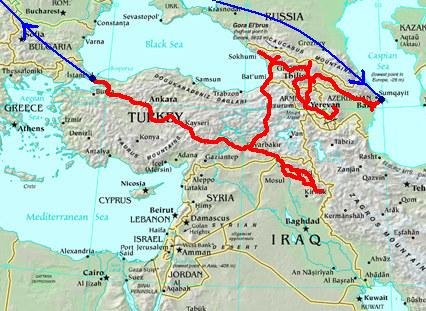
Welcome on my weblog, here I share my travel experiences in Asia. Next summer I will start my trip to Azerbaijan, Armenia, Georgia, Turkey and Iraq. I am planning to travel in that area in July and August, so I start posting from the beginning of July. My intented route is visible on the map. For pictures of my previous journeys in Asia, see http://community.webshots.com/user/mart87.
I hope you enjoy reading my experiences and anecdotes.

Friday, December 15, 2006

Asia 2006 (in DUTCH) - The smile of Laos

LUANG NAM THA EN OMGEVING:
Nadat wij (Guillaume, Yosi en ik) de Chinese checkpost gepasseerd hadden, liepen we 2km door het niemandsland naar de Lao-grenspost. Binnen een kwartier hadden we onze Lao-visas en entry stamps en werden we achterin een minitruck gezet voor een twee uur durende rit naar de dichtsbijzijnde redelijke plaats: Luang Nam Tha. Tijdens de rit passeerden we een aantal dorpen en eindelijk veel jungle. De kinderen in de dorpen zwaaiden naar ons als we lang reden, wat de eerste indrukken van Laos erg positief maakte. De ananas die Guillaume voor tien eurocent in China gekocht had, aten we gulzig op in de truck en even later, tegen vijf uur arriveerden wij in Luang Nam Tha. Daar aangekomen aten we in het eerste restaurant dat we tegen kwamen en vervolgens zochten we een guesthouse. De rest van de avond hebben we met andere reizigers gepraat om zo wat info over de omgeving te krijgen. Na zonsondergang (wat in Laos rond zes uur, half zeven is) is Luang Nam Tha pikdonker, omdat er geen straatverlichting is. Verder zijn veel straten ongeasfalteerd en is de riolering niet overal afgedekt, wat het 's avonds redelijk link maakt om (zonder zaklamp) rond te lopen. Het positieve van dit is dat er ontzettend veel sterren aan de hemel te zien zijn.
De volgende dag wisselden we van guesthouse, omdat het guesthouse waar we de voorgaande nacht sliepen niet bepaald schoon was (met kakkerlakken en een goor toilet). Verder was het guesthouse waar we naartoe verhuisden goedkoper en de familie van het guesthouse ontzettend vriendelijk. Het guesthouse verhuurde ook 110cc motoren, deze hadden we 's ochtends gehuurd en vervolgens gingen we met de motoren raggen door de omgeving van Luang Nam Tha. Omdat ik nooit eerder op iets anders dan een fiets gereden heb en omdat er vier versnellingen op de motorscooters zitten, was het in het begin wat wennen. Binnen een kwartier echter had ik het voertuig onder de knie en reed ik vol gas (85 km/uur) over een rechte weg richting het tankstation. Na zo'n 7 km stopten we bij een tempel, we hebben daar met wat monniken gepraat en wat in de tempel rondgekeken. Wat opviel is dat de Lao tempels zeer anders zijn dan de tempels in China. Laos is boeddhistisch, maar de Lao hangen een andere vorm van boeddhisme aan dan de Chinesen of Tibetanen. De tempels zijn verder erg kleurrijk en versierd met bladgoud.Vanuit de tempel verlieten we de lange geasfalteerde weg en reden we over stoffige zandpaden naar een dorp van de minderheidsgroep Thai-Lu. Het dorp is aanzienlijk anders dan Luang Nam Tha, alleen maar houten paalwoningen (waar in Luang Nam Tha veel stenen woningen zijn), beesten overal (honden, kippen en eenden) en mensen van de minderheidsgroep Thai-Lu. We zagen in het dorp een vrouw zijde maken van zijdewormen en verbaasden ons over de primitieve leefwijze van de dorpsbevolking.
Vanuit het dorp crossten we verder over de zandpaden naar een waterval. De waterval was omgeven door jungle en erg spectaculair. Eenmaal terug van de waterval was het inmiddels vijf uur, en omdat het vrijdag was die dag, moest Yosi terug naar Luang Nam Tha voor de start van Sabbat. Die dag was het ook zijn verjaardag en ik en Guillaume kochten in de tussentijd een cadeau (goedkope Lao-whiskey) voor hem. 'S avonds had ik kramp in mijn maag, waardoor ik vroeg ging slapen.
De volgende ochtend kon Yosi geen geld uitgeven of dingen ondernemen (i.v.m. de Sabbat) en omdat mijn maag niet helemaal genezen was besloot ik het die dag ook rustig aan te doen. Ik had mijn kleren gewassen met de hand in een teil (wat ik nooit van men leven nog eens doe) en heb wat geinternet. Dit was de derde dag in Laos, maar ik wist toen al zeker dat dit land het absolute hoogtepunt van mijn reis zou zijn. Het land is onbeschrijfelijk mooi, het is een van de dunbevolkste landen in Azie, wat het erg rustig en relaxed maakt. De natuur is overal en grote steden zijn niet aanwezig (de hoofdstad Vientiane is ongeveer half zo groot als Utrecht). Verder is de Lao-bevolking fantastisch, mensen glimlachen de hele dag en zijn warm en behulpzaam. De Lao zijn ook erg relaxed en easy-going, wat diepgeworteld zit de cultuur; volgens de Lao is het namelijk ongezond om te veel te werken of te veel na te denken. Het land wordt vaak beschreven als 'the country between today and yesterday' en toen de Fransen naar Indochina (Laos, Cambodja en Vietnam) kwamen vergeleken ze de drie landen als: 'The Vietnamese grow rice, the Cambodians watch the rice grow and the Lao listen the rice to grow'. Het weer in Laos is elke dag geweldig: 'S ochtends bewolkt, overdag warm en zonnig (hoewel het in het zuiden wel erg heet is overdag) en het land is zeer goedkoop (ik geef zo'n 12 euro per dag uit). De Lao spreken haast allemaal redelijk Engels (compleet anders dan in bijvoorbeeld China) en het land is in zekere mate toeristisch, wat het niet lastig maakt om rond te reizen.
Terug naar Luang Nam Tha; de volgende dag nam Yosi deel aan een jungletrek in de omgeving, ik en Guillaume begonnen de dag met banana-shakes in ons favoriete restaurant: Panda restaurant. Vervolgens gingen we per sawngthaew (iets tussen een tuk-tuk en minitruck), door de jungle, naar een dorp genaamd Muang Sing. Deze plaats is bekend vanwege de opiumteelt, het ligt in het hart van de 'Golden Triangle' (belangrijkste drugsregio in Azie), en is verder bekend van de minderheidsvolkeren die in de omgeving leven. In Muang Sing aangekomen vonden we een goedkoop guesthouse, maar behalve dat vonden we niet echt veel. In Muang Sing is nog minder te doen dan in Cothen (heel, heel weinig dus), maar na lang zoeken vonden we een huisje met pooltafels, waar we een aantal uur gepoold hebben. De rest van de avond hebben gedineerd en later Beerlao en lao-lao (sterke drank) gedronken met een groep wilde Japanners.
De tweede dag in Muang Sing huurden we al vroeg mountainbikes en reden we, na het ontbijt, richting de grens met China (niet de grenspost die ik eerder passeerde). Gedurende de tocht passeerden we een aantal interessante dorpen en een prachtig jungle-landschap. Na ongeveer een uur fietsen arriveerden we bij de Lao-grenspost, waar we een tijd met de vriendelijke douaniers gepraat hebben. Na ongeveer een uur bij de grens fietsten we terug en stopten we bij een net geopend guesthouse voor lunch. De lokatie van dit guesthouse was magisch, we konden uitkijken op de eindeloze groene heuvels van Noord-Laos, met nauwelijks dorpen of huizen, want er wonen zeer weinig mensen in deze regio. Toen we onze lunch opgegeten hadden, fietsen we verder over een pad de jungle in, waar we onderweg een vrij grote zwarte slang zagen. Behalve de slang was er niet veel bijzonders, het pad eindigde in het niets. Verder terug richting Muang Sing stopten we nog in een tempelcomplex om wat uit te rusten. Vervolgens fietsen we door het dorp direct naast de tempel, waar we ontzettend veel beesten overal door elkaar zagen lopen. Kalkoenen, honden, kippen, ossen, koeien, varkens, echt alles. Na het dorp kwamen we vast te zitten in een rijstveld en waren we min of meer verdwaald. Uiteindelijk vonden we onze weg terug en spendeerden we de avond weer in Muang Sing. Die avond gingen we weer poolen en sliepen we vroeg na de vermoeiende dag (ik ben op vakantie).
Om acht uur de volgende morgen keerden we per bus terug naar Luang Nam Tha en ontmoetten we Yosi weer, na zijn jungletrek. We haalden onze tassen op in Zuela guesthouse en lunchten we in het beste restaurant dat ik in Laos gezien heb: Panda-restaurant. 'S middags wou ik nog een keer motor rijden en ik huurde weer een 110cc moto voor de halve dag ($3), Guillaume besloot mee te gaan achterop en we reden richting een stupa, niet heel ver vanuit Luang Nam Tha. Omdat het de voorgaande nacht behoorlijk geregend had (enige regen die ik in 40 dagen Laos meegemaakt heb), waren de paden ontzettend blubberig. Ik kwam vast te zitten in de blubber en verloor mijn slipper daar (deze bleef in de modder plakken). We reden terug naar een dorp, kochten een nieuw paar slippers en baggerden verder naar de stupa. We kwamen na een half uur heelhuids bij de glimmende gouden stupa aan en beklommen deze voor een geweldig uitzicht. Vanuit de stupa reden we verder en kwamen uit in een jungledorp. Dit dorp was ontzettend arm, maar het was fascinerend om hier rond te lopen. We zagen de ijscoman arriveren in het dorp, waarna het hele dorp naar buiten kwam om ijs te kopen. Kinderen in het dorp dragen nauwelijks kleding en de houten gammele huizen zijn in erg slechte staat.
Het was tot dan toe de meest indrukwekkende plaats die ik in Laos bezocht heb. Terugrijdend naar Luang Nam Tha kwamen we onderweg zonder benzine te zitten. Gelukkig voor ons stopte er direct een man die ons wat van zijn benzine gaf, wat genoeg was om tot een tankstation te rijden. 'S avonds aten we voor de laatste keer in Panda en besloten we de avond, en het bezoek aan Luang Nam Tha, met een fles beerlao.

NONG KHIAW EN MUANG NGOI NEUA:
Om zeven uur de volgende morgen stond ik op, om vervolgens hectisch naar het busstation te haasten voor de half negen bus naar Pak Mong. Het was een zes uur durende busrit door het heuvelachtige noorden van Laos. Onderweg zagen we in een dorp mensen eekhoorns en een soort katten verkopen (als delicatesse). Toen we in het depot-dorpje Pak Mong aan kwamen, stapten we over in een sawngthaew en reden we in een uur naar Nong Khiaw. Nong Khiaw is een kleine plaats gelegen aan de Nam Ou rivier, met een schitterende karstgebergte omgeving. We vonden een driepersoons kamer in een guesthouse voor $2 ($0.67 p.p.) en genoten vervolgens van de zonsondergang bij de Nam Ou.
De volgende dag werd ik rond 6 uur gewekt door hanen. Nogal gaar stond ik op en had ik mijn ontbijt. Vervolgens namen we de boot naar een afgelegen dorp, stroomopwaards aan de Nam Ou, genaamd Muang Ngoi. Dit dorp is alleen per boot bereikbaar, wat het een zeer relaxte plaats maakt, er rijdt bijvoorbeeld geen verkeer over de stoffige wegen. Het plaatsje heeft zo'n 700 inwoners en deze mensen wonen vrij primitief. Er is alleen electriciteit van 18.00 tot 22.00uur (generator), mensen wassen zichzelf en hun kleding in de rivier, heet water (douche) is niet aanwezig en alle levensmiddelen komen van elders per boot, wat het dorp afhankelijk maakt van andere plaatsen (Nong Khiaw en Luang Prabang). De tocht over de Nam Ou, in een krakende houten boot, was overigens prachtig.
Toen we 's middags in Muang Ngoi arriveerden, vonden we een guesthouse met nog twee bedden over. Omdat we met z'n drieen waren offerde ik mij op en sliep in een hangmat op het terras (meestal slaapt Guillaume op de vloer als we tweepersoons kamers nemen). De volgende dag werd ik om 4 uur gewekt door een haan met een niet goed functionerende biologische klok en het klote-beest liet zijn alarm voor een half uur afgaan. Ik stond dus op en werd wakker met veel Lao-koffie (zeer goede koffie overigens). Later, toen Guillaume en Yosi ook wakker geworden waren, wisselden van guesthouse. We kwamen terrecht in het Banana-guesthouse, waar we een bungalow deelden voor $0.50 per persoon. Het guesthouse wordt gerund door mama en papa (zo moesten we hen noemen) en hun oudste dochter, Lak. Deze mensen zijn echt geweldig, hun gastvrijheid was onbeschrijfelijk. Nadat we onze tassen in de bungalow gedropt hadden, maakten we een wandeltocht naar een grot. Op de heenweg zagen we de grot, maar konden de ingang niet vinden. We liepen dus verder door de jungle en na ongeveer een half uur keerden Yosi en ik terug (het was vrijdag en Yosi moest terug voor Sabbat), Guillaume liep verder. Op de terugweg vonden Yosi en ik de ingang van de grot wel, maar we hadden geen zaklamp bij ons (mijn zaklamp zat in Guillaume's tas), dus we konden de grot niet echt in. Eenmaal terug in het guesthouse dineerden we daar en 's avonds zaten we met een grote groep mensen op het terras. Er was toen een Israelisch koppel, twee Franse neo-hippies, een Amerikaan, een Duitser en wij drieen. We hebben wat gekaart en dronken beerlao.
Om tien uur keerden we echter naar de bungalow, omdat toen de elektriciteit uitviel (in Muang Ngoi hebben mensen 4 uur electriciteit per dag, van 6 tot 10).De dag die volgde heb ik de hele dag in het guesthouse gezeten, ik heb in de zon gelegen en genoten van het uitzicht over de Nam Ou. Later die zaterdag heb ik met Guillaume nog door het dorp gelopen en we bezochten de enige attractie: een tempel. Yosi had die dag zijn Sabbat en we besloten dit met het diner. Na het diner dronken we lao lao met Lak, Edi en Roni (het Israelische koppel) en i.v.m. de electriciteit sliepen we weer vroeg. Het Joodse geloof is voor Yosi ontzettend belangrijk en hij is dan ook vrij orthodox. Dagelijks draagt hij een keppeltje en hij neemt het kosjer-concept zeer serieus (hij heeft zijn eigen pan meegenomen vanuit Israel). Hij bid drie keer per dag en het Zaterdagse ochtend gebed duurt bijna een uur. Zoals alle Israeliers heeft hij drie jaar in het leger gezeten, als scherpschutter en chauffeur van een Humvee. Gedurende zijn legerperiode is hij in zijn schouder beschoten, maar was trots om zijn land te dienen. Voor Guillaume en mij was de orthodoxe en nationalistische cultuur redelijk vreemd, maar we respecteren Yosi's cultuur.
Guillaume en Yosi besloten naar Luang Prabang te vertrekken om daar te zoeken naar een zware motor, ik besloot nog een paar dagen in Muang Ngoi verder te relaxen. Die dag heb ik veel met Lak gekaart en heb de dorpelingen geholpen met het sjouwen van voedsel van de boot naar het pakhuis.
Tijdens het kaarten met Lak, kwam ik veel te weten over haar leven. Zij werkt in een ziekenhuis in Luang Prabang en verdient daar $35 per maand (!). En zij heeft te weinig geld om haar familie in Muang Ngoi vaker dan eens in de vier jaar te bezoeken. Op het moment was zij voor twee weken thuis, na de twee weken zat ze weer voor vier jaar in Luang Prabang, werkende.
Later die dag nam ik een koude douche (of eigenlijk geen douche, maar wasbeurt met een teil en bakje met koud water) en droogde op in de zon. Ik sliep zoals elke dag in Muang Ngoi weer vroeg en ik werd zoals elke dag weer vroeg wakker de volgende ochtend. Dit was mijn laatste dag in Muang Ngoi en ik liep die dag door de rivier naar een eiland om daar wat foto's van de omgeving te maken. De rest van de dag relaxte ik en 's avonds gaven mama, papa en Lak een goodbye-party voor mij. Zij gaven mij fruit, maarliefst negen geluksarmbandjes (tegen kwade geesten) en een ongelofelijk warm afscheid. De morgen die volgde nam ik dus de eerste boot terug naar Nong Khiaw en vervolgde mijn reis met een bustocht naar Luang Prabang.

LUANG PRABANG:
Luang Prabang is de culturele hoofdstad van Laos, het is een plaats met een historisch centrum, eindeloos veel tempels en het wordt door UNESCO als werelderfgoed gezien. Vanwege dit alles is Luang Prabang een vrij toeristische plek met veel guesthouses en restaurants met westers eten. Toen ik daar aangekomen was, zag ik twee Israeliers die ik eerder in Luang Nam Tha ontmoette. We dronken een fruitshake en zij brachten mij daarna naar een goed guesthouse. De rest van de dag heb ik wat door het stadje gelopen en (voor het eerst sinds een week) geinternet. De tweede dag in Prabang deed ik wederom niet heel veel, 's avonds dineerde ik met een Australische en Nederlander en we speelden pool. De dag erna ontmoette ik Guillaume en Yosi in Beit-Chabad (huis van de Joodse gemeenschap), waar Yosi bezig was met een pre-Sabbat gebed. Zij waren op 250cc Honda Baja's door de Sainyabuli-provincie gereden en tijdens de lunch hoorde ik hun verhaal aan.
We wisselden van guesthouse en in de avond ging ik met Guillaume naar de enige disco in Luang Prabang: de Dao Fa-disco. Het was 4km buiten Prabang, dus we gingen er met de Baja naartoe. Na de avond daar gespendeerd te hebben, sloot (zoals alle plekken in Laos) Dao Fa om precies middernacht. Terugrijdende naar Luang Prabang zagen we onderweg een groep mensen aan de kant van de weg staan. We stopten en het bleek dat een vent van zijn motor gevallen was. Hij was buiten bewustzijn, zat onder het bloed en had een enorme wond op zijn hoofd. Een vrouw stopte een voorbijrijdende pick-up en ik hielp de man in de pickup te tillen. Met de vrouw zat ik achterin de pickup, rijdende naar het dichtsbijzijnde ziekenhuis (3km ofzo verderop), Guillaume reed achter ons aan met de Baja. Aangekomen in het ziekenhuis hielp ik de man op een brancard te tillen en vervolgens werd zijn wond direct gehecht. Na een kwartier ofzo kwam de man bij bewustzijn en begon te bewegen en te schreeuwen van de pijn tijdens het hechten. Guillaume en ik werden gevraagd de man onder controle te houden in de operatiekamer, omdat er niet voldoende ziekenhuispersoneel aanwezig was. Het was onbeschrijfelijk hoe slecht en onhygienisch deze hechting verliep en later liep ik wat door het ziekenhuis en verbaasde mij over de situatie daar. In het toilet lag overal bloed op de vloer en mensen slapen soms met zijn drieen in een ziekenhuishuisbed. Verder slapen mensen op de vloer, met kleine kinderen en bejaarden in dezelfde kamer. Dit ziekenhuis was echt de laatste plaats op aarde waar ik naartoe gebracht zou willen worden als een ongeluk heb.....
Na ongeveer een uur waren de doktoren klaar met de hechting en de man werd naar een kamer gebracht. Er stonden drie ziekenhuisbedden in deze kamer, maar er sliepen 15 personen (!). De patienten sliepen met z'n drieen in een bed en de rest slaapt op de vloer. Verder moeten de medicijnen door de patienten zelf betaald worden en als je zonder geld zit krijg je geen operatie of medicatie. Tijdens deze nacht realiseerde ik mij pas echt wat een arm land Laos eigenlijk is. Uiteindelijk reden we om drie uur 's nachts terug naar het guesthouse en sliepen we bijna direct in.
De volgende ochtend was het de tweede december, wat de nationale feestdag van Laos is. Van de festiviteiten had ik niets gezien, omdat ik tot laat in de ochtend sliep na de vermoeiende vorige nacht. 'S middags kwamen de twee vrouwen met wie we de vorige nacht in het ziekenhuis waren naar ons guesthouse om ons te bedanken voor onze hulp. Zij heten Noy en Lanoi en samen met hen zijn we naar een tempel op een heuvel in de stad gegaan. 'S avonds, na het diner besloten Yosi en Guillaume verder te gaan met de Baja's en om negen uur vertrokken zij noordelijk. Ik sliep die nacht vroeg en ontwaakte de dag erna ook vroeg.Overdag werd ik door wat mensen in het guesthouse uitgenodigd om een paar biertjes met hen te drinken. Het bleek dat drie van deze mensen ladyboys waren (half man, half vrouw) en de andere drie waren homosexueel. Het was wat vreemd, maar ik zette mijn vooroordelen weg en genoot van de middag. De jongen die werkte in het guesthouse nodigde mij later uit om mee te gaan naar de bruiloft van een vriend van hem. Dit deed ik en 's avonds reden we naar het dorp waar de bruiloft gehouden werd. Het was in de tuin van een groot landhuis en buiten zat een enorme mensenmassa. Honderden mensen waren voor de bruiloft gekomen en het was dus ontzettend druk. Bij binnenkomt groetten we de bruid en bruidegom en kregen we een glas whiskey als welkomsdrankje. De rest van de avond bestond uit een diner en traditioneel dansen. Het was erg bijzonder om bij deze bruiloft aanwezig te zijn geweest en het was zeer gezellig. Tegen middernacht keerden we terug naar het guesthouse.
De volgende ochtend stond ik vroeg op en ging ik door de stad lopen. Ik zag ontzettend veel tempels en liep langs de Mekong. Dit was echt de sightseeing dag en ik maakte veel foto's van het mooie Luang Prabang. In de avond dineerde ik met een oude Fransman die met een Lao vrouw getrouwd was en in een dorp dichtbij Prabang woonde. Hij vertelde mij wat meer over de Lao-cultuur, wat vrij interessant was. Na het diner genoot ik van een zonondergang bij de Mekong en werd ik verrast door...Guillaume en Yosi. Het bleek dat Guillaume onderweg ergens gevallen was van zijn motor op een zeer slechte weg. Het was niet ernstig, maar hij wilde niet meer verder rijden. Bovendien eindigde de weg die zij namen in het niets, dus ze moesten sowieso terugrijden.
Wat we toen de volgende dag gedaan hadden was het verhuren van Guillaume's motor aan een andere Israelier genaam Shalam. Hij zou de motor, samen met Yosi, via een alternatieve route terug naar Vientiane rijden en Guillaume en ik zouden hen dan na een paar dagen in Vientiane ontmoetten. Die dag waren we dus bezig met het regelen van dit en verder hadden we wat gerelaxed in Beit-Chabad voordat Yosi en Shalam vertrokken. 'S avonds ging ik poolen met Guillaume en gingen we voor de tweede keer naar Dao Fa (...), waarmee we het bezoek aan Luang Prabang sloten. Nog een ding wat erg opvalt in Luang Prabang zijn de tuk-tuk chauffeurs. Behalve dat zij een tuk-tuk besturen hebben ze een tweede bezigheid, namelijk het dealen in drugs. Over straat lopend in Luang Prabang kom je continu tuk-tuk bestuurders tegen die naar je fluisteren: 'Smoking ganja, cheapah cheapah', 'Hello sir, you want smoke?'........

Tuesday, November 28, 2006

Asia 2006 (in DUTCH) - Southwestern China

GUIZHOU:
Zoals gezegd eindigde ik de vorige email in Chongqing, ik nam vanuit daar een bus naar de stad Guiyang, gelegen in de provincie Guizhou. Na een busrit van ruim 8 uur kwam ik aan in Guiyang, waar ik direct een busticket kocht naar Kaili, waar ik zo'n drie uur later arriveerde. In Kaili aangekomen ging ik op zoek naar een goedkoop hotel, wat ik na een minuut of tien gevonden had. Kaili is een redelijk grote plaats in het Zuidoosten van de provincie. De regio wordt vooral bewoond door kleurrijke minderheidsvolken, de Miao, de Gaija en de Dong, en dat is in de straten van Kaili ook goed te merken. Het is een vrij relaxte plaats en ik besloot om er de volgende dag te blijven. Die dag heb ik niet veel gedaan, ik ben wat door het stadje wezen dwalen en 's avonds heb ik met een Chinese gast whiskey gedronken in een foute disco (veel prostituees). De dag erna besloot ik naar een Miao-dorp te gaan genaamd Chong'an. Ik vertrok vanuit Kaili rond 12 uur 's middags en toen ik tegen half vier in Chong'an aangekomen was vond ik een klein guesthouse. Ik was de enige gast daar, maar de oude Chinese eigenares was erg vriendelijk en gaf mij wat tips voor wandeltochten in de omgeving. In de namiddag liep ik wat rond in het dorp wat gelegen is aan een schone rivier, omgeven door groene heuvels. De huizen in het dorp zijn in traditioneel Chinese stijl en de omgeving is schitterend. De straten zijn erg modderig en overal lopen beesten, de inwoners zijn vriendelijk maar ook vrij gereserveerd.
De volgende ochtend maakte ik de wandeltocht naar het Gaija-dorp Xin Zhal, wat de vrouw in het guesthouse mij aanbevolen had. De tocht was over een modderig pad de heuvels in. Langs rijstterrassen en dichtbegroeide, groene heuvels met houten huisjes verstopt in de begroeiing. Ik zag de Gaija mensen in de rijstvelden en met hun buffels aan het werk en ik werd een aantal keer opgehouden omdat er buffels over het pad liepen. Na een uur gelopen te hebben kwam ik een groep Gaija mannen tegen, ook opweg naar Xin Zhal, en met hen liep ik verder naar het dorp. Daar aangekomen werd ik door deze mensen uitgenodigd voor lunch en ze begonnen direct met het inschenken van baijo (zeer sterke Chinese drank). Omdat ik ook nog naar beneden moest lopen over de slibberige modderpaden en dat graag in nuchtere staat wou doen, bleef ik niet heel lang bij de dorpelingen en maakte mijn weg naar beneden. Eenmaal terug in Chong'an ging ik per bus terug naar Kaili, waar ik tegen de avond aankwam. Terug in het hotel ontmoette ik een Zwitserse vrouw, de eerste westerling die ik sinds Xiahe gezien heb en de rest van de avond heb ik met haar gepraat. Zij had net als ik al weken geen westerling gezien, dus het was fijn om na al die tijd eens met iemand te kunnen communiceren.
De volgende dag ging zij naar een dorp ergens ten zuiden van Kaili, ik ging per bus naar de stad Guiyang. Die dag was het overigens de 31ste oktober (mijn verjaardag), maar ik heb het niet echt gevierd, ik heb die dag drie uur in de bus gezeten en sliep die avond daarom redelijk vroeg. De volgende dag had ik een ticket voor de nachttrein naar Kunming gekocht en totdat mijn trein vertrok heb ik door de Chinese miljoenenstad gelopen. Hoewel de Chinesen Guiyang een provinciestadje noemen, is het een enorme stad met ruim 2 miljoen inwoners. Guiyang is echter niet veel anders dan andere Chinese steden en net zoals in andere Chinese steden is er niet veel bijzonders te zien.
Die avond vertrok ik dus per nachttrein naar Kunming, de hoofdstad van Yunnan. Aangekomen in Kunming kocht ik een ticket voor de nachtbus naar Lijiang en ik moest toen nog een half etmaal op mijn bus wachten. Ik besloot naar een hostel te gaan waarvan ik eerder een folder gevonden had en daar heb ik met wat andere westerlingen gepraat en koffie gedronken. Later die middag ging ik met een Britse naar een boekwinkel, waar ik een reisgids voor Cambodja gekocht heb. Tegen achten nam ik een taxi naar het busstation voor de nachtbus naar Lijiang.

LIJIANG:
De volgende ochtend kwam ik vroeg aan in Lijiang en even later vond ik een Youthhostel in het oude stadscentrum. Vorig jaar was ik ook in Lijiang geweest, en ik heb contact gehouden met een groep Chinese schoolmeisjes die Engels studeren, het meisje dat ik van vorig jaar kende heet Brooke (Engelse naam, haar Chinese naam ben ik vergeten). Die middag had ik haar opgebeld en even later ontmoette ik hen in de binnenstad. Ze lieten mij hun school zien, een vrij groot complex met saaie witte gebouwen, sportvelden en accomodatie voor de studenten. Later lunchten we in een stadspark en liepen we wat door Lijiang.
Lijiang is heel erg toeristisch, met vooral veel Chinese tourgroepen. De reden dat het stadje zo toeristisch is, is vanwege de historische gebouwen en de smalle steegjes die de gebouwen van elkaar scheiden. Het is origineel een Naxi-stadje, de Naxi is een minderheidsvolk met eigen kleurrijke klederdracht. Hoewel het zo ontzettend toeristisch is, en soms voelt als een Chinese kermis, is Lijiang een fijne plek om een aantal dagen te blijven.
De tweede dag dat ik in Lijiang was, was het de verjaardag van Brooke. Ik werd uitgenodigd om met haar en wat vriendinnen naar een toeristisch Naxidorp te gaan om daar wat rondtehangen en te lunchen. Het dorp is net als Lijiang overstroomt met Chinese toeristen, maar ondanks dat was het een fijne middag. 'S middags heb ik zelf wat door Lijiang gelopen en geinternet, 's avonds was het verjaardagsfeestje. Ik werd uitgenodigd om naar de bar van Brooke's oom te komen, waar ik een enorme groep Chinese tieners aan een grote tafel aantrof. We vierden de verjaardag met taart, snacks en Dali-beer. Het was erg leuk om met al deze Chinesen te praten en na die avond kende ik bijna al Brookes klasgenoten.
De volgende dag heb ik niet veel gedaan, ik heb wat gerelaxed in het guesthouse en mijn kleding gewassen. 'S avonds heb ik met een Chinees/Canedese jongen gegeten en later dronken we wat.
De dag erna heb ik wat gelezen in het hostel en wat gehangen met Cherry, een Chinese toerist uit Guiyang, en een groep Jappanners. Die avond ben ik terug naar de school gegaan voor een avondklas. Ik heb de studenten daar geholpen met hun Engels en tips gegeven over hoe zij het beste Engels kunnen studeren. Na de les dronken we koffie in de school en vervolgens keerde ik terug naar mijn youthhostel.
De dinsdag die volgde heb ik een Engelse les bijgewoond in de school. De Engelse docent was zelf behoolijk slecht in Engels (zoals de meeste Chinesen) en ik moest hem continu corrigeren. Als hij de studenten een nieuw woord leerde sprak hij het fout uit en het boek dat gebruikt wordt is ronduit waardeloos. Ik herrinner mij een opdracht 'correct the errors in the sentences' en bij elke zin die de docent voor gedaan had, maakte hij alleen maar meer fouten in de zinnen. Maar hoewel de docent waarschijnlijk beter is in Papiamento dan in Engels, had hij veel gevoel voor humor en maakte de lessen erg gezellig. Na de les lunchte ik met de studenten en nam ik afscheid van hen, ik had namelijk gepland die middag naar Dali te vertrekken. Maar eenmaal terug in het hostel besloot ik nog een extra nacht in Lijiang te verblijven en ging daarom de volgende ochtend pas naar Dali. Ik vertrok de dag erna samen met Cherry en de twee Jappanners naar Dali, waar we rond 4 uur 's middags arriveerden.


DALI:
Toen ik in Dali aankwam en ging in-checken bij het guesthouse trof ik Bart-Jeroen ineens aan. Hij is een Nederlandse gast die ik ken vanuit Almaty, Kazachstan. Hij reist per fiets van Turkije naar Indonesie en was toevallig ook in Dali. Hij kwam net aan vanuit Kunming met een aardig Zwitsers koppel en met zn vieren dineerden we daarna. Eenmaal terug in het guesthouse, na het diner, trof ik op het terras voor mijn kamer Cherry aan met een grote groep Jappanners, zij waren druk bezig met het drinken van wijn en ik en Bart-Jeroen werden uitgenodigd om mee te doen. Later kreeg een van de Jappanners ruzie met een vrouw van het personeel, omdat zij door hem niet konden slapen. Hij werd later 'The bad man from Osaka' genoemd door haar, het was hilarisch hen bezig te zien.
De ochtend die volgde heb ik het grootste deel van de dag op het terras in de zon gezeten met Bart-Jeroen, Cherry en een man uit Singapore. Later die dag heb ik nog twee mensen ontmoet die ik al eens eerder onmoet had. Namelijk de Israelier Igor (ik heb 10 dagen met hem in Noordwest China gereisd) en Yosi, een andere Israelier die ik kort in Xiahe gesproken heb. Dali was voor mij min of meer de plaats van de rendez-vous, wat ik erg leuk vond uiteraard.
Het stadje Dali zelf had ik, net als Lijiang, vorig jaar ook al gezien, maar het is een mooie historische plaats en een goede plek om een aantal dagen te blijven plakken. Wat erg typisch is aan Dali zijn de oude vrouwtjes op de straat die drugs verkopen. Zittende op een terras in Dali, geheit dat er hordes vrouwen naar je toe komen met een fotoboekje met ansichtskaarten. En hoewel het op het eerste gezicht lijkt alsof ze je kaarten proberen te verkopen, wordt hun eigenlijke verkoopwaar snel ontmanteld nadat ze je 'smoking ganja, cheapah cheapah' het oor in fluisteren. Waarschijnlijk vanwege de nabijheid van de drugslanden Laos en Myanmar en mede omdat marihuana-planten rondom Dali in het wild groeien, maakt het Dali drugshoofdstad van China. Maar afgezien van het drugsverhaal is Dali en de omgeving van Dali in het bijzonder erg plezierig.
Terug naar het terras: nadat ik dus een hele dag op het terras gehangen heb, druk bezig zijnde met rendez-vous'en, vond ik dat het tijd werd om de dag erna iets nuttigs te gaan doen. Die ochtend vertrok Bart-Jeroen met zijn fiets richting Myanmar, en ik maakte samen met Yosi en Yosh (Nederlander) een fietstocht door de omgeving. Dali is gelegen aan een groot meer genaamd het Erhai Hu, en we fietsten richting het meer op onze goede mountainbikes. Bij het meer aangekomen kwamen we terrecht in een moerassig stuk met jumbo-spinnen in de bomen om ons heen. Even later kwamen we uiteindelijk bij de kust van het schitterende meer aan en er kwam een visser met zijn aalscholvers voorbij varen. We wilden graag de visser met zijn vogels aan het werk zien, dus we riepen hem naar ons toe. Hij nam ons voor 2 euro per persoon mee in zijn boot en op het meer konden we hem zien aalscholver-vissen. Hij had een vogel of 10 en hij stuurt de vogels het water in om vis voor hem te vangen. En omdat de aalscholvers een touwtje om hun nek hebben, kunnen zij de grote vissen niet doorslikken, zodat de visser deze kan vangen. Het is een fascinerende manier van vissen en zeker het hoogtepunt van mijn bezoek aan Dali. Overigens heb ik het aalscholvervissen vorig jaar ook al in Yangshuo gezien, maar in Yangshuo was het gemaakt voor toeristen. Deze man in Dali deed het vissen echt als zijn beroep, wat de beleving veel reƫler maakte.
Nadat we terug aan de kant gezet werden en de visser bedankte, lunchten we in een klein dorp en fietsten we even later terug naar Dali. Op de terugweg konden we overigens de marihuana planten zien, het groeit er overal in het wild. De rest van de middag heb ik een pakketje met post naar Nederland verstuurd. 'S avonds heb ik een film in het guesthouse bekeken en heb ik met Yosh en Yosi gepoold in een bar.
Met Yosh ging ik de middag erna per bus terug naar Kunming, de grootste stad in Yunnan. Yosi bleef in Dali, voor een drie-daags verblijf in een Tai-chi klooster, maar omdat hij ook opweg is naar Laos, heb ik afgesproken hem voor de grens weer te ontmoeten om samen naar Laos te gaan.

KUNMING EN XISHUANGBANNA:
Kunming is de laatste grote stad die ik zou zien voor Phnom Penh in Cambodja (waar ik zon 6 weken na Kunming aan plan te komen) en verder was Kunming de laatste plaats voordat ik echt de tropen in ging. Ik besloot met deze redenatie in het achterhoofd een paar dagen in Kunming te blijven om mij op de jungle's van Zuidoost Azie voor te kunnen bereiden.
Ik kwam aan in Kunming samen met Yosh in de namiddag, hij ging direct per trein verder naar Chengdu. Ik stapte in een taxi en deze bracht mij naar het guesthouse waar ik eerder al een halve dag gebleven was. Aangekomen in het guesthouse zag ik weer een aantal bekende gezichten: de twee Nederlanders Ruud en Gert-Jan, waarmee ik in Lijiang eerder al een tijd gepraat heb, en een Brits koppel dat ik kort in Dali gezien heb. Met hen spendeerde ik de rest van de avond, ik at in het guesthouse en we dronken wat samen.
De volgende dag in Kunming heb ik in het guesthouse rondgehangen met een Fransman die ik daar ontmoette. Zijn naam is Guillaume en hij was ook op weg naar Laos. Die dag heb ik een aantal films gekeken en met Guillaume gepoold. De dag erna heb ik 25 dvd's gekocht, samen voor zon 16 euro. Verder heb ik eindelijk mijn Chinese Yuan om kunnen wisselen in US-Dollars (heb ik nodig voor Laos) en vervolgde ik datgene waar ik de dag ervoor druk mee was: films kijken en poolen. In de avond vertrok ik met Guillaume naar het busstation voor de nachtbus naar Jinghong, een stad niet heel ver van de grens met Laos.
Jinghong is gelegen in het autonome Xishuangbanna, de enige tropische regio van China en het gebied voelt daarom meer Zuidoost-Aziatisch dan Chinees. Het tropische merkten we al direct toen we aankwamen in Jinghong, we arriveerden om 7 uur 's ochtends, maar het was toen al zwetend warm. Binnen een half uur na aankomst vonden we een guesthouse met bamboe-hutten en bananenbomen, waar we voor een euro per nacht verbleven. Toen we vervolgens ontbeten liepen we Yosi weer tegen het lijf (de Israelier die ook op weg is naar Laos) en we brachten hem naar het bamboo-guesthouse. De rest van de dag hebben we met zijn drieen door de stad gelopen, waar ik voor het eerst de machtige Mekong-rivier gezien heb. Vanaf Jinghong zou ik de Mekong gaan volgen totaan Phnom Penh (Cambodja), dus het was wel bijzonder om de rivier voor het eerst te zien.
De stad voelt zoals gezegt heel anders dan China, de straatnamen staan op de verkeersborden in het Zuidoost-Aziatische Dai-schrift aangegeven (naast het Chinees), mensen zien er kleurrijker uit en de straten van Jinghong zijn aangelegd tussen rijen palmbomen. De sfeer is goed in Jinghong, wat het een plezierige plaats maakte om voor een dag te stoppen.
De dag die volgde gingen we richting de grens met Laos, we vertrokken met de vroegste bus naar het stadje Mengla, op een uur van de grens. De busrit was door de junlge en omdat dit de eerste keer was dat ik jungle gezien heb, maakte dat de rit erg bijzonder. Toen we stopten voor de lunch in een klein dorp kochten we een ananas voor 1Y (0.10euro), deze zouden we later de dag in Laos op gaan eten.
Na de 5 uur durende busrit arriveerden we in Mengla, waar we direct vervoer geregeld hadden naar de grenspost Mohan. De chauffeur die ons in zijn busje naar de grens bracht was behoorlijk slaperig en sloot zijn ogen af en toe voor een aantal seconden terwijl hij aan het rijden was. Dit was nogal beangstigend, maar we kwamen uiteindelijk heelhuids in Mohan aan. In Mohan aangekomen passeerden we de gemakkelijke Chinese grenspost binnen een half uur, wisselden we onze laatste Yuan om in Lao Kip en liepen we twee kilometer met onze tassen door het niemandsland naar het land waar ik mij op dit moment bevindt: the Lao People's Democratic Republic.