It is 9.30 in the morning and I am standing in front of the 7-eleven next to the University metro station in Hong Kong. I haven't slept last night as I had to finish two geography papers. I drank the 5th cup of coffee since midnight and I met two of my fellow exchange students Hans and Theresa (both German). Together we went on Hong Kong's perfect MTR metro system to the border with Mainland China at Lo Hu. At the Chinese immigrations the border guard looked at my passport picture for quite a long time and then, while pointing at my picture, asked me: 'is this you?'. For a second I thought telling him: 'no its that Chinese guy over there, can't you see?'. But I kept my patience and said: 'yes, its me'. Than the border guard flicked through my passport and found my Hong Kong student visa. He asked me: 'are you a student?' After that long night of studying, I almost lost control and for a while I thought of telling him: 'no I am a terrorist who is going to make a suicide attack in your country'. But I stayed cool and said: 'yes I study in Hong Kong'. OK sir, welcome to China!

Shenzhen is a huge city directly after the border from Hong Kong. It is one of the 'Special Economic Zones', which basically means it consists of kilometers of factories and concrete buildings. I guess most people never heard of Shenzhen, but it actually is one of the largest cities in China, population wise it is with 8 million inhabitants even bigger than Hong Kong. For tourists there is nothing to see in Shenzhen really, but flying from Shenzhen's airport is cheap, that's why we went there. We catched our China Southern flight to Shanghai's Hongqiao airport and after arrival we took a bus to our remarkably nice hostel smack in the center of bustling Shanghai.

Next day I went with Hans and Theresa on a day trip to Hangzhou. From Shanghai we hopped on one of China's newly developed high-speed trains, which brought us to Hangzhou in less than 2 hours. This high-speed railway system is one sign of China's rapid modernization. Within the last ten years, a high-speed railway system has been built around Beijing-Tianjin, Shanghai-Nanjing-Hangzhou and in the Pearl River Delta (around Guangzhou and Shenzhen). To compare, it took the Dutch government over 25 years to work on a high-speed railway track from Amsterdam to the Belgium border (which is less than 200km). Still it is not completely finished. Not to mention the reconstruction of Amsterdam's main railway station, which has been a construction site for the past 5 years and isn't finished yet.

Anyway, we arrived in Hangzhou, a large typical Chinese city and the capital of Zhejiang province. We met some of Hans' friends at Hangzhou's railway station and we strolled along Hangzhou's famous 'West Lake' (Xi Hu). The beautiful lake, the boats in the lake, the colors of the trees and the peaceful atmosphere made it a really nice walk and we rewarded ourselves with a nice lunch afterwards. In the afternoon we vis
ited a tea plantation and hiked a bit up a hill for a view over the city. On the hill we saw a colorful Chinese wedding ceremony in a small temple. We warmed up a bit with coffee and went back to Shanghai.

Back in Shanghai I continued my search for China's modern soul. With the Germans I went to some of Shanghai's best clubs, where the newly rich and famous Chinese spend their Renminbi on expensive Tsingtao beers and cocktails. By coincidence I met Joanne outside a club at 3am in the night. Joanne is a Shanghainese woman who works for a PR-company. The very strange thing here is that I met her for the first time in Beijing .... 3 weeks before; the world is very small. The following days she would show me some more of what Shanghai is all about and I met lots of her friends.
The Germans left Shanghai a few days earlier than me, because I had to spend some extra days in an internetcafe in order to finish another geography paper. In the few hours I wasn't studying, I went into the Grand Hyatt hotel, one of the most expensive hotels in Shanghai. The reason was a to see Shanghai's impressive skyline from the rooftop lounge bar on the 32nd floor of the hotel. Modern China at it's best.

Completely different than Beijing, Shanghai really represents the modern soul of China. The open-mindness of the Shanghainese contrasts with the more traditional way of living in Beijing. The city is the economic heart of China, while Beijing has the role of being the political center in the country. The flip side of the coin is the enormous gap between rich and poor people, which is enormous in Shanghai compared with other Chinese cities. Dressed up in nice suits and driving around in new BMWs, Shanghai is home for the richest Chinese. On the other hand, the city is filled with beggars, prostitutes and a high number of poor workers from the countryside. The contrast between rich and poor or traditional and modern is nowhere in China as huge as in Shanghai. But that is exactly what makes it a very interesting metropolis. After 5 days already, I was a bit sad to leave the booming city, but I decided to continue my journey southwards.

Next day I met some guys in People's Park, who invited me for a traditional Chinese tea ceremony, which turned out to be very nice. Afterward I rushed to the bus station to catch my relaxing sleeper to Quanzhou, 15 hours south of Shanghai in Fujian province. I arrived early in the morning and went to the city center on the back of a motorbike. I found myself some baozi for breakfast and strolled around the city. Quanzhou is for Chinese standards not a large city (population over 2 million....), but had historical importance in the time of the maritime silk road. In the days of Arabian traders, Quanzhou was one of the most important ports in the world and the Arab influence is still visible today in Quanzhou's large Muslim community and heritage. I visited the main mosque and strolled a bit through the old streets of the city. The chaotic streets of Quanzhou are filled with motorbikes, scooters and bicycles, which suit the subtropical climate of Fujian province. My walk brought me past some traditional houses to a temple with two beautiful pagodas. The area is surrounded by a park and made a worthwhile stop.


After several hours of sightseeing in Quanzhou, I hopped on a bus to one of China's major coastal cities, Xiamen. Like Quanzhou, also Xiamen is an important historical port, especially during the time of European trade when the city was called Amoy. Today, Xiamen still is one of China's major port cities, especially because it is (like Shenzhen) a Special Economic Zone. During my stay in Xiamen I went for a day to Gulangyu Island, which is just a 10 minute ferry ride away. The island had been a European enclave since the treaty of Nanking in 1842 and this is visible in the numerous European style buildings on the island. Walking on Gulangyu feels a bit like being in a mass of Chinese tourists somewhere in Portugal, as the island really looks like a Mediterranean town in Europe. I climbed a large rock in the middle of the island for a view over the Taiwan strait on one side and Xiamen city on the other. Afterwards I enjoyed a coconut on the subtropical beach and took a ferry to the city. Back in Xiamen I walked a bit around in the old part of the city and went to my hostel to get my backpacks. I walked to the bus station and catched a bumpy sleeper bus to Shenzhen, from where I crossed the Hong Kong immigrations.

In conclusion of this journey, all the cities I visited (probably with the exception of Quanzhou) are very much representing modern China. Skylines filled with flashy skyscrapers and the newly rich consuming their hardly earned Renminbi, it is very evident in China's eastern cities. On the other hand, the differences between rich and poor are much more vast here than in the West of the country. Totally different than agricultural based Western China, the East coast very much represents the ambitions of modernization. And Shanghai undoubtedly is the pearl of it.
 Quanzhou
 Shanghai
 Xiamen
 Haikou
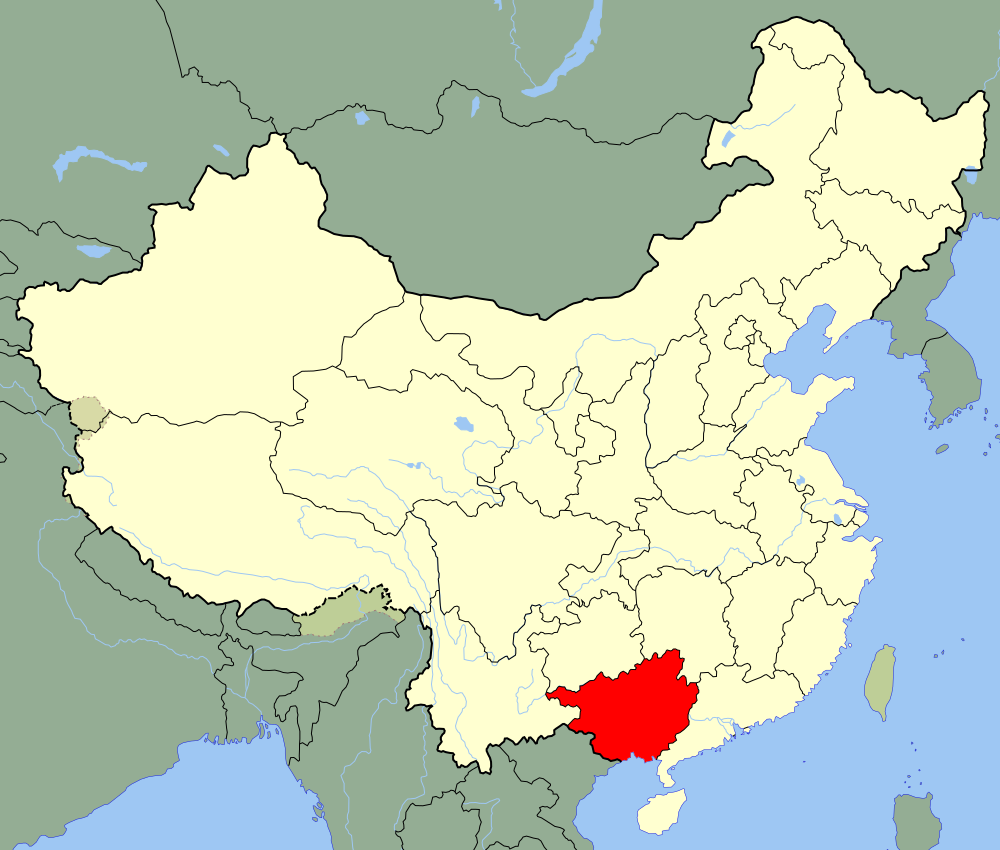
 Longji Riceterraces
 Guilin


 Yangshuo


 This sixth journey through China started in the city I called home for the past 4 month: Hong Kong. It was a few days before Christmas and I started to arrange some 'check-out procedures' at the Chinese University. I already knew that after I crossed the border to China, I couldn't come back to Hong Kong, as I didn't had enough space in my passport for a new Hong Kong student-stamp (that is a good reason ha?). So I really had to arrange everything before crossing the border. I finished my last geography paper, packed all my stuff, said goodbye to my friends and moved to a guesthouse in Causeway Bay. I picked up my father from the airport and we stayed a few days in Hong Kong, visiting its major tourist sites. We went up Victoria Peak for some skyline views, walked around in Tsim Sha Tsui
  and Central for some skyscrapers and I showed him around the Chinese University. As a day-trip we took a ferry to Cheung Chau island, which has a totally different atmosphere than the city. One of the things I liked most of Hong Kong is the diversity of its territory. Standing in the middle of one of Asia's largest cities, you can be laying on an empty beach with a view over beautiful islands within half an hour. Hong Kong is much more than just a city; it has a huge backyard full of islands, mountains, forests and villages. So my father Frans and I went to Cheung Chau, which is a small island just half an hour by ferry from Central Hong Kong. We hiked a bit around the island, stopped at a few nice viewpoints and temples and enjoyed a cold Tsingtao beer afterward.


 I met some of those Chinese on top of a hill in the park, who asked me to be on a photo with them. Really funny to be on someone's photo without knowing them, also a typical China experience. After the park, my dad and I went to another highlight of Guilin: the Lude cave. Guilin's karst formations host lots of caves and Lude probably is the most beautiful. The cave is absolutely huge and well lit inside. In a side cave we visited a 1000 year old turtle, who is kind of worshiped, the animal is so old that he barely moves.

 Pa'an village is, besides tourism, based on agriculture. Chicken, dogs, ducks and pigs walk along its narrow streets, which make the scene of this picturesque village complete. We stayed in a friendly wooden guesthouse, but as the temperature dropped during the night it got freezing cold there. Two thick blankets made me survive the weather and next day we hiked a bit more and hopped on a bus back to Guilin.

 All sleeper tickets were sold out, so the long journey to Guangzhou turned out to be a tough one. I strolled a bit around in Guangzhou and went on to Shenzhen. I finished this sixth China journey at Shenzhen's Bao'an airport, from where I flew to Bangkok.
 December 5th, Hong Kong, China
 Shenzhen is a huge city directly after the border from Hong Kong. It is one of the 'Special Economic Zones', which basically means it consists of kilometers of factories and concrete buildings. I guess most people never heard of Shenzhen, but it actually is one of the largest cities in China, population wise it is with 8 million inhabitants even bigger than Hong Kong. For tourists there is nothing to see in Shenzhen really, but flying from Shenzhen's airport is cheap, that's why we went there. We catched our China Southern flight to Shanghai's Hongqiao airport and after arrival we took a bus to our remarkably nice hostel smack in the center of bustling Shanghai.