


MURMANSK


APATITY

BOAT KEM' - SOLOVETSKY


SOLOVETSKY ISLANDS


 After my early arrival in the city, I walked around the parks and along the lake shore, stopping for some breakfast on the way. Around noon I hopped on a hydrofoil, named 'Krasnaya Kometa' (Red comet), to an island in the lake called Kizhi Island.
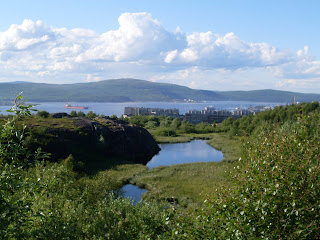
 When I told Sergey that I planned to stay in the Khibiny mountains, we contacted Olga, one of his friends who stays by herself in the mountains. Also they offered to bring me by car to Apatity, which is a mining town in the mountains. The ride to Apatity was really beautiful and went very fast as Aleksander was driving a constant 140 km/h over a terrible road. We passed the industrial town Monchegorsk and we arrived in Apatity quite late.
 Finding Olga however, turned out to be a very difficult task. First, we had to contact friends of Olga in Apatity, Ksenya and Roman, who had to draw a map for me with the walking route to Olga's camp. Afterwards, we went to a huge industrial complex, from where I started my hike uphill into the mountains. Without Ksenya's map, I would have been completely lost, and luckily I found Olga. She stayed for about three weeks by her own in a small tent somewhere in the middle of nowhere.
 The Solovetskiy Islands are famous for its World Heritage listed Solovetskiy monastery, situated in the middle of the island. The Orthodox monastary was founding in the 15th century and has been an important religious centre in northern Russia. However, during the Soviet period, Stalin turned the monastery into a labor camp (Gulag) and prison for 'political opponents'. In 1974 the Gulag was closed and it became a museum and monastery again.

 Pskov is a city with a long and proud history, also being one of the oldest cities in Russia. The city is famous for Alexander Nevsky's battle with the German Teutonic knights on the frozen Peipus Lake and for its beautiful Kremlin. But coming from Estonia, Russia was kind of a cultureshock, especially for Stephan, Jurjen and Davey. There is garbage all over the place, pavements are in terrible condition and with all the grey apartment blocks, the outskirts of Pskov look pretty grimm. And after a long walk from the trainstation to our hotel, we were confronted with Russian bureaucracy again. It took us about an hour just to check in to 'Hotel Krom' and we had to pay some strange 'registration fee' of 200 rubles each, but the room was nice though.
Our walk in the city was really nice, the Kremlin of Pskov is absolutely beautiful. It is situated on the banks of both the Volkhov and Pskov rivers and the views over the river and city are fabulous. We walked along the main street to Lenin square, where a big statue of Vladimir Ilich himself is still standing. Also we saw lots of nice Orthodox churches, which reflects the rich history of Pskov. Besides our sightseeing tour we ate in a good italian restaurant and we spended some time waiting in an internet cafe for the rainy weather to change. We also had a lot of fun taking Lada and Volga taxis, as they are extraordanary cheap and I love those Russian made cars. 
Getting to Pskov from Estonia was really easy, but leaving the town is a different story. Not so much because there is a lack of transport, the main problem is buying a trainticket. The Russian railways are not the most efficient ones and it took us one and a half hour waiting in line just to buy a ticket. Also here we experienced the bureaucratic system. We managed to get the ticket anyway and we took a nighttrain to Saint Petersburg. We bought the cheapest tickets (platskartny) and after the short night we arrived in St Peterburg's Vitebsky trainstation. 
In 1703, Peter the Great ordered his people to build St Petersburg (or 'Piter' as the locals call it) with the aim of creating the most beautiful and glorious city in the world. He also had the aim to create a city which could serve as a 'window to Europe' and to be Russia's new Baltic port. A couple of years after Petersburg's creation, it served as the capital of the Russian empire. Until 1917 when the communists moved it back to Moscow and changed its name into Leningrad. The architecture of St Petersburg is mostly based on western European cities, including Amsterdam, which is visible at the cities canals. Therefore today, St Petersburg is probably the most European city of Russia and with a population of over 4.5 million, it's the second largest in the country.
 After our arrival at Vitebsky station we travelled by Peterburg's efficient metro to our hostel. And after some resting I walked with Davey along Nevsky Prospekt (the most famous street in Russia) to find a place to do our laundry. Finding the laundry place turned out to be pretty difficult and actually we spended most of the day searching for those well hidden washing machines. During the time we waited for our clothes to be washed, we walked a bit admiring the beautiful churches, boulevards and palaces. The city feels as a huge museum packed with nicely decorated buildings.
On our second day in Piter, we visited the Hermitage, a huge art museum on the Neva river. Luckily, I managed to get all for of us in for free by showing my fake (bought in Bangkok) ISIC student card. So with free enterance, we were happy to walk around past the numorous Picassos, Dutch masters and other arts. The Hermitage actually is so huge that it is almost impossible to see everything in just a day. But as we are not the greatest art-lovers, we spended only a couple of hours before continuing our walks along the Neva, catching a cold Baltika beer on a terrace.  Continuing our walking tour we went to Peter&Paul Fortress, an island in the Neva river, and after we strolled past some of the most beautiful Orthodox churches in the city.
As in Russia is some kind of weird 'registration' policy, which means that one is not allowed to stay longer than 3 days in a Russian city without official registration, we had to make a daytrip out of Petersburg. We chose to travel to Novgorod, 3 hours south of SPB. From the busstation we hopped on a bus towards Novgorod, but unfortunately it broke down after 10 minutes and we had to wait for another bus 2 hours later. The Russian customer service was not exactly friendly, but we got a bus to Novgorod anyway. Sitting in the tiny bus cramped on the last seat, there was a guy opening a 2 liter beer bottle, which he was emptying during the busride. This actually is a typical scene on Russian streets or basically everywhere in the country.
 After our arrival in Novgorod, we walked towards the city centre, dropped our bags in 'Hotel Akron' and relaxed in the evening. That night, I read some history about Novgorod and I discovered that the city is one of the oldest in Russia. It used to be a main trade post for the Varanga Vikings, who sailed down Russia's rivers and created the settlement in 862. Later Novgorod became a strong, independent kingdom and the political center of Kyivan Rus. Today, Novgorod is a relaxing town with a laid-back atmosphere and some striking sights. The main one being the impressive kremlin on the bank of Volkhov river. Inside the kremlin is St Sofia's Cathedral and some other religious buildings. The other side of the river hosts Yaroslav's court, which basically is a large park filled with old churches.

Luckily, the day we visited Novgorod was pretty warm and sunny and the riverside beach was full of sunbathing people that day. We enjoyed some nice shashlyk before catching a terribly slow elektrichka (suburban train) back to Saint Petersburg. We spended the night in the same hostel we stayed before and the day after I brought Jurjen, Davey and Stephan to Pulkovo Airport for their flight back home. From that moment onwards, I continued travelling solo, with Russia's north as my first destination. I took a nighttrain to the capital of Karelia republic, Petrozavodsk, that evening.
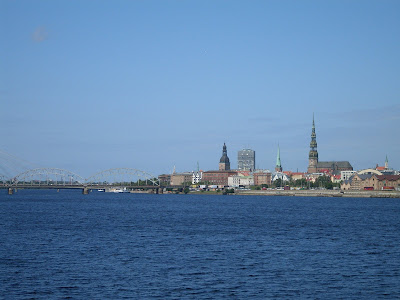 From Liepaja we catched a bus to the Latvian capital Riga, which turned out to be a nice two-hour ride through the Livonian countryside. Arriving in Riga, it was directly visable that it is a completely different city than Vilnius. The Latvian capital is more cosmopolitan, has a art-nouveau center (unlike the baroque style in Vilnius) and is far more touristic. Riga used to be a Hanseatic (Hanze) city back in the 12th century and now it is the big boy of the Baltics.
 After a day of walking through town, including Riga's TV-Tower for amazing views over the Daugava river and the city skyline, we spent the evening watching some cheap movies with some fun older British travellers. On the last day in Riga, I did some more walking in the city center with Davey, adoring the beautiful churches and cozy squares.


 St.Petersburg highway, to a small village called Viitna. The reason we visited Viitna is because it is right in the middle of Lahemaa nature park, a quiet area full of forests and lakes. We stayed there in wooden huts, next to a beautiful lake. After all the cities we visited, I really enjoyed staying in a nature area for a while, it was a good opportunity to relax for a day. And although we enjoyed walking the forests a lot, the highlight of Viitna actually was a stand with the most amazing shashlyk. We enjoyed their shashlyk (kind of kebab, Soviet style with unions and lavash) for both dinner and breakfast.
-------------------------------------------
Saturday, June 21th, Utrecht, Netherlands
In the early morning we stand at Jaarbeursplein in our beloved city Utrecht, waiting for our bus straight to Kaunas, Lithuania. Soon after, our ramshackle bus arrived and we took seat in a bus f ull of Russian holidaymakers. Sitting right in front of the television, I was blessed to watch bad Russian soaps during the 26 hour journey. Although the journey was long and I rather saw the television being switched off than watching more soaps, I enjoyed the bus ride. In the bus we met one other Dutchman, Joop, who married a Lithuanian woman and told us a lot of 'cowboy-stories' varying from Soviet corruption and South African politics to all the celebrities he had met in his life. There was one major downside of our bus journey though. During the night our bus stopped at a gas station somewhere in Poland and we went inside to buy some drinks. Inside the gasstation was a television which showed the European football championship. We saw Holland lose against the Russians...
Next morning, we arrived in Kaunas. The city used to be the old capital of Lithuania and now is a pleasant provincial city. We stayed in a church transformed into a hostel and I played some chess with Stephan, who became addicted to the game. After we walked a bit around and settled down for a couple of beers. With some more walking and drinking next morning, we left Kaunas around noon to the Lit huanian capital Vilnius.
Vilnius really is a beautiful city. Back in 2004 I was amazed by the quantity of churches, baroque-buildings and the cozy center of town. And on that journey, I remember that I enjoyed Vilnius most of the three Baltic capitals. This time, I also enjoyed Vilnius a lot. The city has the largest baroque town center in Europe, while the atmosphere is pretty laid back. We stayed in a good hostel, close to both the city center and the railway station, where we cooked a nice spaghetti-meal on the first day. Except for the four of us, there was  an other guest from Holland in Vilnius, namely our Queen Beatrix. We haven't seen the Queen ourselves, but there was lots of security all over the city and we could see Dutch flags waving next to the Lithuanian ones.
The three days that we stayed in Vilnius, we spent walking around the town center, climbing some hills for a city view and visiting churches. In the evening we went to a club called 'Broadway', where we met some nice local people.
Quite amazing on the second day was the weather. While at first the day started nice and sunny, there was extremely heavy rainfall in the afternoon. It rained so hard that the streets were under water. Also see the small video.

From Vilnius we took a train straight to the other side of the country, to the harbourcity Klaipeda. The train ride was pretty comfortable and relaxing, with nice views of the Lithuanian countryside. Klaipeda itself is not really pretty, although the center has some nice buildings and picturesque streets. But the main reason we went to Klaipeda was to visit the Curonian spit, a  nature park stretching from the Russian exclave Kaliningrad to Klaipeda. Together with Jurjen, we hired bicycles and cycled to the ferry across Curonian Lagoon to a village named Smiltyne. From there we cycled all over the Curonian spit for about 50km. The area is full of forests, sand dunes, picturesque villages and it has nice views over the Baltic Sea. The only negative part of our cycling tour was the presence of a large group of senior nudists who ruined the nice views over the Baltic Sea.
Heading back for Klaipeda, Jurjen's bicycle got a flat tire so we had to share one bike and hold the other one for the last 10km. To make it worse, the weather suddenly changed and there was a huge dark cloud above us. With heavy rain and thunder heading towards us, I drove like a  maniac to the ferry port back to Klaipeda. Luckily, we just made it to the ferry before the rain started. In Klaipeda I relaxed a bit in the hostel, talking to a funny American guy and an older Norwegian man, who traveled together with his three kids. We left Lithunia by bus north, along the Amber road (amber is one of the most important export products of the region), to Liepaja, a harbor city in Latvia. In Liepaja, we found a guesthouse to stay in, owned by a friendly woman who only speaks Latvian and Russian. So for me it was an opportunity to practice my Russian a bit.
The town Liepaja actually is not a really nice place. It is a city with lots of abandoned buildings and the city center felt quite depressing. The city serves as one of Latvia's most important ports (together with Ventspils further north), which dominates the atmosphere in the city. In Liepaja, there was visibly a high rate of unemployment combined with alcoholism and the problems which both cause. The actual reason we visited Liepaja, was to see Karosta, a district north of the city. Karosta used to be an important base of the Soviet military fleet and used to be a restricted area until the late 1990's. Now it is open to visitors and the highlight being a former military prison in the middle of the district. We visited the prison by taking a tour with a funny guide (see its picture), who told us about the history of the prison and the way of living inside.

Besides Karosta's prison, we walked a bit around the district, which now mostly is abandoned. By coincidence later during my journey, I met Lyuda, a girl from Vologda (in Russia) who actually grew up in Karosta, as her father served in the Soviet army. She was quite surprised that I could show her some pictures of the district and she told me some more about the living conditions there in the 1980's.
