Tuesday, August 12, 2008

White nights and hospitality in the Russian north

I started my journey towards the Russian Arctic with an overnight train to Petrozavodsk. This city, which literally means 'Peter's Factory', was build at the same time as Saint Petersburg and contributed to Peter the Great's army by producing weapons during the Northern war against Sweden. Today, Petrozavodsk is the capital of the republic of Karelia. And with its location on the shore of Lake Onega (Europe's second largest lake) and with its lovely parks, Petrozavodsk is quite a nice town.
After my early arrival in the city, I walked around the parks and along the lake shore, stopping for some breakfast on the way. Around noon I hopped on a hydrofoil, named 'Krasnaya Kometa' (Red comet), to an island in the lake called Kizhi Island.
This island is famous for its world-heritage listed wooden church, which is said to be built without a single nail. Although there are quite some (mostly Russian) tourists, Kizhi is really beautiful and I enjoyed wandering around on the island. Besides the amazing Transfiguration Church (the big one on the picture), there are lots of other wooden buildings and the setting within the lake made it a highly rewarding destination.
Back in Petrozavodsk I went to a restroom on the train station (Komnata otdykha), which basically is the cheapest form of accommodation in Russia. I shared a room with two other men. With one of them, Leonid, I talked for quite some time, discussing life in Karelia and his job as woodcarver. Leonid is a tattooed guy with golden teeth, who used to be a car mechanic in Orsha (Belarus), but moved to Karelia after he lost his job in the rough 1990s.
On my second day in Petrozavodsk I just wandered around a bit. And when I walked on Lenin street (every Russian town has a Lenin street), I stopped in front of the university as there was a huge crowd of people and lots of police men standing there. When I asked someone what was going on, the guy told me that president Medvedev visited the university. And when I looked towards the entrance of the building I actually saw him standing there, in the company of some other important looking people. I was just 30 meters or so away of Dmitry Medvedev......
From Petrozavodsk I continued traveling north and I bought a ticket to another Karelian town called Kem'. On the train, I talked for some time with a girl named Yulya, who is a rocket science student from Moscow on her way to a catamaran holiday on Kola peninsula. Also I had some conversations with the young conductor (provodnik), who forgot to wake me up when the train stopped in Kem', which caused that I had to continue further north. I managed to get a big discount for the continuing journey to Murmansk and on the way I enjoyed a beautiful Arctic landscape, full of lakes, forest and tundra.
Arriving in Murmansk, I went to an expensive hotel to use their internet and I called Sergey, who I met through hospitalityclub. Soon after, I met him and his friend Aleksander and they brought me to a town called Abram Mys, where they offered me accomodation in the apartment of one of their friends, Vlaclav. The following three days I spended hanging around with Vlaclav, Sergey, Aleksander and a lot of their friends. They showed me Murmansk, its surroundings and the meaning of warm Russian hospitality.
To tell something about the city of Murmansk; it is the largest town above the Arctic circle in the world and one of Russia's most important ports. This is due to its location on the Barentzsea, which is ice-free all year (because of the warm current). The city itself is quite industrial (because of the harbor activities) and rather grey. However, the surrounding area is very beautiful, with Arctic forest, some hills, lakes and the wide Kolskiy Bay (see the video). But besides the Arctic nature, perhaps the most special natural phenomenon is the white polar night. In summer, the sun doesn't set for a couple of months and I witnessed 24 hours of daylight.
As I am writing this story by the time I already left Russia, I can conclude that out of all places I stayed in Russia, I enjoyed my visit to Murmansk most of all. Because of its Arctic nature, the white nights and the incredible hospitality of the people I met here. Sergey, Aleksander and Vlaclav drove me around, showed me the nice spots and we had lots of talks and drinks in the night. They also took me to an open air festival, which basically is a gathering of young people on a location a bit out of the city.
When I told Sergey that I planned to stay in the Khibiny mountains, we contacted Olga, one of his friends who stays by herself in the mountains. Also they offered to bring me by car to Apatity, which is a mining town in the mountains. The ride to Apatity was really beautiful and went very fast as Aleksander was driving a constant 140 km/h over a terrible road. We passed the industrial town Monchegorsk and we arrived in Apatity quite late. Finding Olga however, turned out to be a very difficult task. First, we had to contact friends of Olga in Apatity, Ksenya and Roman, who had to draw a map for me with the walking route to Olga's camp. Afterwards, we went to a huge industrial complex, from where I started my hike uphill into the mountains. Without Ksenya's map, I would have been completely lost, and luckily I found Olga. She stayed for about three weeks by her own in a small tent somewhere in the middle of nowhere.
The only day I stayed in her camp was really terrible. There was only some instant food, I had to drink water from a river and I was cutting woods for 4 hours. Right in front of the tent was a pile of animal shit. And when I asked Olga what kind of animal had been shitting in front of our tent, she told me it was of a bear.... The nature however was very beautiful and after a short hike I enjoyed an amazing view over Apatity (see the video). I haven't seen any bears though, but I was a bit scared of seeing them.
After the day I stayed in the mountains, I was happy to make the hike back down. I walked through the forest back to the factory, from where I managed to hitchhike with a police man back to Apatity. I bought some food in a supermarket and made my way to the trainstation, where I catched a train to Kem' (the town I missed before). The reason I went to Kem' was to hop on a boat to the Solovetsky Islands, which I did right after my arrival the next morning. The boat ride however was very shaky and I got a bit seasick during the 3 hour journey on the White Sea.
The Solovetskiy Islands are famous for its World Heritage listed Solovetskiy monastery, situated in the middle of the island. The Orthodox monastary was founding in the 15th century and has been an important religious centre in northern Russia. However, during the Soviet period, Stalin turned the monastery into a labor camp (Gulag) and prison for 'political opponents'. In 1974 the Gulag was closed and it became a museum and monastery again.
When I arrived there, I was wandering a bit around in the search for cheap accomodation. On the way I met a woman, Lyudmila, who tried to help me finding the places I was looking for. When all the cheap places turned out to be full, she offered me to stay in the apartment she was staying. Lyudmila is a university professor on Belgorod univeristy (in the south of Russia, close to Ukraine) and she went to Solovetskiy for holiday. She travels together with a colleague, also named Lyudmila, and the two days I spended on the island were mostly with them. We walked a bit on the beautiful islands and they teached me some of the monastery's turbolent history. The monastery is for a large part still in reconstruction (after communists burned it down in 1922), but the revival of religion was clearly visible. Lots of bearded priests wandered around and women had to wear headscarfs in order to get inside. The churches are highly decorated and the richness of the Russian Orthodox church is showed with great pride. I was very thankful to Lyudmila and Lyudmila, who helped me a lot on the islands and I enjoyed the conversations we had. After two days however, I went back to Kem' to continue my journey more southwards.

Friday, July 25, 2008

Splendour of Saint Petersburg

In this summer journey, Russia for me is the most important destination. After intensively studying Russian language for the last year and specializing my geography studies on the former Soviet Union, I really wanted to visit the Russian Federation. Actually it is the second time I visit Russia, the first time being a journey to Moscow and along the Trans Mongolian railway to Ulaanbaator. But with just two days in the capital, I couldn't really say I had been to Russia. So my intention to visit Russia is mostly based on practicing my Russian, to travel the historical center of the country and to view Russia's nature in the European north.
We entered Russia by bus from Tartu, Estonia. The bus trip was nice, although the driver really drove like a madman. On a 70km/h road, he easily drove 130, bumping the ramshackle bus towards the border. Surprisingly, the border crossing was pretty straightforward and compared with other former Soviet Union border quite easy. On the Russian side of the border, we talked a bit with an Orthodox priest, who told us about the history of Pecheri monastery (which is 10km from the border). Continuing along the terrible road (which actually is a 'paid-road'), we hopped off the bus in first city in Russia: Pskov.
Pskov is a city with a long and proud history, also being one of the oldest cities in Russia. The city is famous for Alexander Nevsky's battle with the German Teutonic knights on the frozen Peipus Lake and for its beautiful Kremlin. But coming from Estonia, Russia was kind of a cultureshock, especially for Stephan, Jurjen and Davey. There is garbage all over the place, pavements are in terrible condition and with all the grey apartment blocks, the outskirts of Pskov look pretty grimm. And after a long walk from the trainstation to our hotel, we were confronted with Russian bureaucracy again. It took us about an hour just to check in to 'Hotel Krom' and we had to pay some strange 'registration fee' of 200 rubles each, but the room was nice though.

Our walk in the city was really nice, the Kremlin of Pskov is absolutely beautiful. It is situated on the banks of both the Volkhov and Pskov rivers and the views over the river and city are fabulous. We walked along the main street to Lenin square, where a big statue of Vladimir Ilich himself is still standing. Also we saw lots of nice Orthodox churches, which reflects the rich history of Pskov. Besides our sightseeing tour we ate in a good italian restaurant and we spended some time waiting in an internet cafe for the rainy weather to change. We also had a lot of fun taking Lada and Volga taxis, as they are extraordanary cheap and I love those Russian made cars.
Getting to Pskov from Estonia was really easy, but leaving the town is a different story. Not so much because there is a lack of transport, the main problem is buying a trainticket. The Russian railways are not the most efficient ones and it took us one and a half hour waiting in line just to buy a ticket. Also here we experienced the bureaucratic system. We managed to get the ticket anyway and we took a nighttrain to Saint Petersburg. We bought the cheapest tickets (platskartny) and after the short night we arrived in St Peterburg's Vitebsky trainstation.

In 1703, Peter the Great ordered his people to build St Petersburg (or 'Piter' as the locals call it) with the aim of creating the most beautiful and glorious city in the world. He also had the aim to create a city which could serve as a 'window to Europe' and to be Russia's new Baltic port. A couple of years after Petersburg's creation, it served as the capital of the Russian empire. Until 1917 when the communists moved it back to Moscow and changed its name into Leningrad. The architecture of St Petersburg is mostly based on western European cities, including Amsterdam, which is visible at the cities canals. Therefore today, St Petersburg is probably the most European city of Russia and with a population of over 4.5 million, it's the second largest in the country.

After our arrival at Vitebsky station we travelled by Peterburg's efficient metro to our hostel. And after some resting I walked with Davey along Nevsky Prospekt (the most famous street in Russia) to find a place to do our laundry. Finding the laundry place turned out to be pretty difficult and actually we spended most of the day searching for those well hidden washing machines. During the time we waited for our clothes to be washed, we walked a bit admiring the beautiful churches, boulevards and palaces. The city feels as a huge museum packed with nicely decorated buildings.

On our second day in Piter, we visited the Hermitage, a huge art museum on the Neva river. Luckily, I managed to get all for of us in for free by showing my fake (bought in Bangkok) ISIC student card. So with free enterance, we were happy to walk around past the numorous Picassos, Dutch masters and other arts. The Hermitage actually is so huge that it is almost impossible to see everything in just a day. But as we are not the greatest art-lovers, we spended only a couple of hours before continuing our walks along the Neva, catching a cold Baltika beer on a terrace. Continuing our walking tour we went to Peter&Paul Fortress, an island in the Neva river, and after we strolled past some of the most beautiful Orthodox churches in the city.
As in Russia is some kind of weird 'registration' policy, which means that one is not allowed to stay longer than 3 days in a Russian city without official registration, we had to make a daytrip out of Petersburg. We chose to travel to Novgorod, 3 hours south of SPB. From the busstation we hopped on a bus towards Novgorod, but unfortunately it broke down after 10 minutes and we had to wait for another bus 2 hours later. The Russian customer service was not exactly friendly, but we got a bus to Novgorod anyway. Sitting in the tiny bus cramped on the last seat, there was a guy opening a 2 liter beer bottle, which he was emptying during the busride. This actually is a typical scene on Russian streets or basically everywhere in the country.

After our arrival in Novgorod, we walked towards the city centre, dropped our bags in 'Hotel Akron' and relaxed in the evening. That night, I read some history about Novgorod and I discovered that the city is one of the oldest in Russia. It used to be a main trade post for the Varanga Vikings, who sailed down Russia's rivers and created the settlement in 862. Later Novgorod became a strong, independent kingdom and the political center of Kyivan Rus. Today, Novgorod is a relaxing town with a laid-back atmosphere and some striking sights. The main one being the impressive kremlin on the bank of Volkhov river. Inside the kremlin is St Sofia's Cathedral and some other religious buildings. The other side of the river hosts Yaroslav's court, which basically is a large park filled with old churches.

Luckily, the day we visited Novgorod was pretty warm and sunny and the riverside beach was full of sunbathing people that day. We enjoyed some nice shashlyk before catching a terribly slow elektrichka (suburban train) back to Saint Petersburg. We spended the night in the same hostel we stayed before and the day after I brought Jurjen, Davey and Stephan to Pulkovo Airport for their flight back home. From that moment onwards, I continued travelling solo, with Russia's north as my first destination. I took a nighttrain to the capital of Karelia republic, Petrozavodsk, that evening.

Sunday, July 20, 2008

Baltic Capitals and Estonian nature

From Liepaja we catched a bus to the Latvian capital Riga, which turned out to be a nice two-hour ride through the Livonian countryside. Arriving in Riga, it was directly visable that it is a completely different city than Vilnius. The Latvian capital is more cosmopolitan, has a art-nouveau center (unlike the baroque style in Vilnius) and is far more touristic. Riga used to be a Hanseatic (Hanze) city back in the 12th century and now it is the big boy of the Baltics.
Jurjen, Stephan, Davey and I spent the first night in the 'Old Town' Hostel, which is situated above a bar, where we tried the local spirit Rigas Balzalms together with a Scottish tourguide James. The second day we moved to another place, the 'Argonaut' Hostel, which actually is one of the best hostels I ever stayed in. It is ranked as the 8th best hostel in Europe, which I defenitely can confirm.
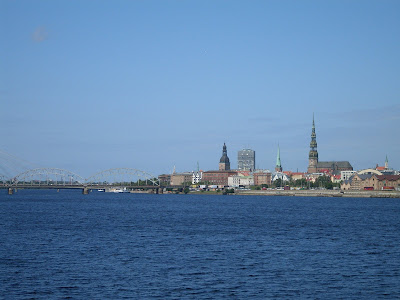
After a day of walking through town, including Riga's TV-Tower for amazing views over the Daugava river and the city skyline, we spent the evening watching some cheap movies with some fun older British travellers. On the last day in Riga, I did some more walking in the city center with Davey, adoring the beautiful churches and cozy squares.
We left Riga by bus (using busses is the most efficient way of getting around in the Baltics) to Parnu, Estonia. Parnu is a beach town on the shore is the Gulf of Riga and the town has a cozy atmosphere. We stayed in a hostel which used to be a hospital, where we made ourselves some spaghetti. In the evening we had numorous 'apple-pies' (vodka, cinnamon and apple-juice) in one of Estonia's better clubs, club Bravo.
From Parnu we continued our journey north to Tallinn, the capital of Estonia. Arriving at Tallinn's busstation, we had a long walk towards the city center, where we stayed in a bad, but cheap, hostel. Tallinn probably is the most beautiful Baltic city, as it is like a fairytale city with a beautiful old town, full of white churches. We went to Toumpea hill for some amazing views over Tallinn's red roofs and we walked past numorous churches, the nice city wall and other historical buildings.
At the time we were in Tallinn, there was a festival going on named Ollesummer (Beersummer), which is like the Estonian version of Munich's Oktoberfest. We visited Ollesummer for one afternoon, trying out local breweries and listening to live music. There even was a poker-stand, where we played Texas Hold'em with 6 Estonian guys. Jurjen won the table by the way.
Comparing Estonia with the other Baltic countries, it feels much more Scandinavian than Latvia and Lithuania. Estonian language is very similar to Finnish (unlike Latvian and Lithuanian which are close to Slavic languages) and I found the Estonians a bit more reserved. The landscape is in a couple of ways more like Scandinavia, with lots of lakes and pineforests.
From Tallinn we travelled eastwards, along the Tallinn-St.Petersburg highway, to a small village called Viitna. The reason we visited Viitna is because it is right in the middle of Lahemaa nature park, a quiet area full of forests and lakes. We stayed there in wooden huts, next to a beautiful lake. After all the cities we visited, I really enjoyed staying in a nature area for a while, it was a good opportunity to relax for a day. And although we enjoyed walking the forests a lot, the highlight of Viitna actually was a stand with the most amazing shashlyk. We enjoyed their shashlyk (kind of kebab, Soviet style with unions and lavash) for both dinner and breakfast.
Travelling to Viitna was easy, but leaving the town is another story. We intended to travel to Estonia's second largest city, Tartu, which turned out to be quite difficult. We changed busses a couple of times, to arrive in an uninspiring town called Tapa, where we catched a train to Tartu. In Tartu we just spended the night, cooking some fish and pasta, because we left early the morning after towards the Russian Federation.

Tuesday, July 15, 2008

Along the Amber Road

Friday, June 6th, The Hague, Netherlands
It's 11 am on a sunny Friday morning. Together with three good friends from my hometown, Jurjen, Stephan and Davey, I am staying in a que. We already waited for an hour or two, outside of a small building in the center of The Hague. The time we were waiting already, we spent checking our passport and invitation forms several times. Half an hour or so later, we were in front of the line and the security guard finally let us in the building of the Russian embassy. Inside of the embassy, we completed our visa application forms and queued up for 20 minutes more.
12 am, we're first in line and I submitted our passports, application forms and invitations to the nice-looking girl behind the desk.
'Do you have a receipt of your pre-paid accommodation in Russia?', she asked.
'Why do you need a receipt, we already got the invitation and accommodation vouchers, don't we?', I told her.
'Without a receipt, no visa'.
The security guard escorted us to the exit door. This was our first experience with Russian bureaucracy.
Although the denial of our visa application felt as a defeat, after all our effort to get the invitation stuff, we still managed to obtain a Russian visa after all. We went to a specialized agency the next week.
And with a colorful Russian visa in our passport and a bus ticket to Lithuania, we were ready for the journey through the Baltic States, Russia and Belarus.
The planning for my journey is simple. At first I would travel with Davey, Jurjen and Stephan through Lithuania, Latvia and Estonia towards St.Petersburg. From there my friends would fly home and I'm off alone for Russia and Belarus (for a map of my planned route, see the previous post).
For me it is the first time I travel in a group of four, but it's the second time I'm visiting the Baltic States. Actually, the very first time I traveled solo, back in autumn 2004, was a journey through the Baltics and Poland. It was two weeks before my seventeenth birthday and I pretty well remember that I really enjoyed the historic Baltic capitals, with Vilnius being my favorite.

-------------------------------------------
Saturday, June 21th, Utrecht, Netherlands

In the early morning we stand at Jaarbeursplein in our beloved city Utrecht, waiting for our bus straight to Kaunas, Lithuania. Soon after, our ramshackle bus arrived and we took seat in a bus full of Russian holidaymakers. Sitting right in front of the television, I was blessed to watch bad Russian soaps during the 26 hour journey. Although the journey was long and I rather saw the television being switched off than watching more soaps, I enjoyed the bus ride. In the bus we met one other Dutchman, Joop, who married a Lithuanian woman and told us a lot of 'cowboy-stories' varying from Soviet corruption and South African politics to all the celebrities he had met in his life. There was one major downside of our bus journey though. During the night our bus stopped at a gas station somewhere in Poland and we went inside to buy some drinks. Inside the gasstation was a television which showed the European football championship. We saw Holland lose against the Russians...

Next morning, we arrived in Kaunas. The city used to be the old capital of Lithuania and now is a pleasant provincial city. We stayed in a church transformed into a hostel and I played some chess with Stephan, who became addicted to the game. After we walked a bit around and settled down for a couple of beers. With some more walking and drinking next morning, we left Kaunas around noon to the Lithuanian capital Vilnius.
Vilnius really is a beautiful city. Back in 2004 I was amazed by the quantity of churches, baroque-buildings and the cozy center of town. And on that journey, I remember that I enjoyed Vilnius most of the three Baltic capitals. This time, I also enjoyed Vilnius a lot. The city has the largest baroque town center in Europe, while the atmosphere is pretty laid back. We stayed in a good hostel, close to both the city center and the railway station, where we cooked a nice spaghetti-meal on the first day. Except for the four of us, there was an other guest from Holland in Vilnius, namely our Queen Beatrix. We haven't seen the Queen ourselves, but there was lots of security all over the city and we could see Dutch flags waving next to the Lithuanian ones.

The three days that we stayed in Vilnius, we spent walking around the town center, climbing some hills for a city view and visiting churches. In the evening we went to a club called 'Broadway', where we met some nice local people.

Quite amazing on the second day was the weather. While at first the day started nice and sunny, there was extremely heavy rainfall in the afternoon. It rained so hard that the streets were under water. Also see the small video.


From Vilnius we took a train straight to the other side of the country, to the harbourcity Klaipeda. The train ride was pretty comfortable and relaxing, with nice views of the Lithuanian countryside. Klaipeda itself is not really pretty, although the center has some nice buildings and picturesque streets. But the main reason we went to Klaipeda was to visit the Curonian spit, a nature park stretching from the Russian exclave Kaliningrad to Klaipeda. Together with Jurjen, we hired bicycles and cycled to the ferry across Curonian Lagoon to a village named Smiltyne. From there we cycled all over the Curonian spit for about 50km. The area is full of forests, sand dunes, picturesque villages and it has nice views over the Baltic Sea. The only negative part of our cycling tour was the presence of a large group of senior nudists who ruined the nice views over the Baltic Sea.
Heading back for Klaipeda, Jurjen's bicycle got a flat tire so we had to share one bike and hold the other one for the last 10km. To make it worse, the weather suddenly changed and there was a huge dark cloud above us. With heavy rain and thunder heading towards us, I drove like a maniac to the ferry port back to Klaipeda. Luckily, we just made it to the ferry before the rain started. In Klaipeda I relaxed a bit in the hostel, talking to a funny American guy and an older Norwegian man, who traveled together with his three kids. We left Lithunia by bus north, along the Amber road (amber is one of the most important export products of the region), to Liepaja, a harbor city in Latvia. In Liepaja, we found a guesthouse to stay in, owned by a friendly woman who only speaks Latvian and Russian. So for me it was an opportunity to practice my Russian a bit.
The town Liepaja actually is not a really nice place. It is a city with lots of abandoned buildings and the city center felt quite depressing. The city serves as one of Latvia's most important ports (together with Ventspils further north), which dominates the atmosphere in the city. In Liepaja, there was visibly a high rate of unemployment combined with alcoholism and the problems which both cause.
The actual reason we visited Liepaja, was to see Karosta, a district north of the city. Karosta used to be an important base of the Soviet military fleet and used to be a restricted area until the late 1990's. Now it is open to visitors and the highlight being a former military prison in the middle of the district. We visited the prison by taking a tour with a funny guide (see its picture), who told us about the history of the prison and the way of living inside.

Besides Karosta's prison, we walked a bit around the district, which now mostly is abandoned. By coincidence later during my journey, I met Lyuda, a girl from Vologda (in Russia) who actually grew up in Karosta, as her father served in the Soviet army. She was quite surprised that I could show her some pictures of the district and she told me some more about the living conditions there in the 1980's.

Friday, June 20, 2008

Summer journey through the Baltic States, Russia and Belarus


On the map here, I drew the intended itinerary for my summer journey. I plan little less than 2 months for visiting Lithuania, Latvia, Estonia, European Russia and hopefully Belarus (if I can get a Belorussian visa though....).
I hope you enjoy reading my travel stories on Eastern Europe.

Tuesday, March 18, 2008

Chişinău, the concrete capital of Moldova

After our arrival in Targu Mures, we walked for about an hour with heavy backpacks in order to find the bus station. Arriving at the bus station, Jurjen and I found out that we missed the last bus in the direction of Moldova. There was no option for us but to spend the night in Targu Mures. With the Lonely Planet city map of Targu Mures, we walked for about half an hour more to find out that the cheapest hotel in the city, 'hotel Sport', turned into some kind of hospital a couple of months ago and that the hotel simply doesn't exist anymore. A lady from the next door bowling hall described it as: hotel Sport... finito! So unfortunately, there were no cheap accommodation possibilities left. We decided to spend the night in a three-star hotel right next to the bus station, as we had the intention to leave boring Targu Mures as soon as possible. We ended up paying 22 euro each for the room, which is expensive with my budget, but ok for just one night. And the hotel was really nice with good beds and a nice hot shower. During the evening, we bought some food in an XL Kaufland supermarket, which was a couple of minutes walking from our hotel. Later that night, we enjoyed our nice hotel room and watched a bit of Romanian television before sleeping. Next morning we woke up at 6 am, took a quick shower and had breakfast in the hotel. Our minibus towards the Carpathian mountains left at 07.30am, which we catched luckily. The ride was really nice, we traveled through the mountains and we passed several small villages. It was clearly visible that we were driving in a poor part of Romania, as the way of living there is still quite primitive. The scenery was amazing, with beautiful valleys, distant mountains and sleepy towns. Around noon, the driver stopped somewhere halfway in a village next to a mountain lake. We ate something and continued our journey further east, through a hilly area towards Romania's second largest city: Iasi (pronounce as 'Yash').

Arriving in Iasi, we directly searched for transportation to the Moldovan border. It appeared that our only option was to take a shared taxi to Ungheni, which is the first town on the Moldovan side of the border. Quite quickly we found a driver, who already had two Moldovan passengers and was willing to take us to Moldova. After negotiation of the price we left for the 20km ride to the border. The friendly driver had some contacts at the border post and managed to get us across the border very quickly. Our passports were stamped and before we knew, we were driving on an empty road in one of the poorest countries in Europe: the republic of Moldova.
Moldova is a small and quite an unknown country lying between Romania and Ukraine. The reason we went to Moldova is because virtually no tourists spend their holiday time there. Moldova probably is the least visited country on the European continent, which makes it an
interesting destination to us. Both culturally and ethnically, Moldova is quite similar to Romania. The main difference is that Moldova used to be part of the Soviet Union and Romania was ruled by the Ceausescu regime. The first place where we arrived after the border crossing is an industrial town called Ungheni. The people from the shared taxi helped us finding a marshrutka to Chişinău and we continued our journey eastwards. Being cramped on the tiny seats and being shaked around because of the bumpy road, we were happy to arrive in the Moldovan capital a couple of hours later.
The Moldovan capital really is a strange place. In a way, the city is nice because of its laid back atmosphere and cozy parks. But on the other hand, Chişinău doens't have any sights and isn't a touristic destination at all. Almost all buildings in Chişinău are uninspiring concrete monsters dating from the Soviet period. The city doesn't really have a cozy centre like other European cities have and because we visited Moldova in february, the city and its inhabitants looked rather grim.
However, staying in Moldova was a nice experience for a couple of reasons . First of all, we found a very cheap hotel and discovered that food and other expenses are quite cheap compared to Romania. The hotel were we stayed is a huge concrete Soviet building with unhelpful staff and dusty furniture, dating from the 1950s. But because of its low price and good location, we enjoyed staying there. The second thing which I liked about Moldova was the ability to practise my Russian. Lots of Moldovans speak Russian and Chişinău has quite a large Russian population. Studying Russian for over half a year already, it was a nice opportunity for me to practise. And although touristic sites in Chişinău are very rare, we did saw some nice churches and interesting buildings. Also the simple street plan made it easy to orientate around the city.
The second day in Chişinău we had lunch in the largest fast-food joint of the country, named Andy's Pizza. It is like a Moldovan counterpart to McDonalds and there are restaurants of Andy's Pizza spread out all over the city, almost at every streetcorner. The place where we went into was completely full, which is quite logical, because they serve huge pizza's for amazingly low prices. The menu consists, besides the pizza's, a large selection of vodka brands and other alcoholic drinks.
We left Chişinău on the third day, on a nighttrain back to Bucharest. Especially the ride before the Romanian border was really nice and we spended some time talking about Dutch football with a Romanian guy in the restaurant wagon. Also see the short video about the trainride below.
The bordercrossing to Romania however, was annoyingly slow. In total it took about 4 hours just at the border. One of the reasons is the changing of the carriages of the whole train. Romania uses European railway tracks, while Moldovan has Russian railway tracks, which are a bit more wide. Therefore, the whole train had to be lifted so that all the carriages could be changed.
The morning after, we arrived in Bucharest and walked towards the city centre for some breakfast and a bus to the airport. We catched our flight back to Dortmund and travelled back home by train.
Reflecting back on this journey, I would say that I like Romania more, as it is much more beautiful than Moldova. Our visit to Moldova however, was really interesting and I am also glad I visited that tiny country. One other highlight of our visit was the amazing weather. I expected heavy snow and february-like temperatures, but it was totally the opposite. Nice sunny days with a comfortable temperature between 15 and 20 degrees Celcius.

Sunday, March 16, 2008

Short journey to the country of gypsies and Dracula

In the last week of february, I set of for a 10 day journey through Romania and Moldova. Although usually I travel solo, this time I went together with a friend from Wijk bij Duurstede (its the place where I live), Jurjen. We decided to travel to Romania mostly out of interest in the Eastern Balkan, but secondly because of the cheap flying possiblity. We booked a returnflight from Dortmund (Germany) to Bucharest with an el-cheapo flightcompany called Wizz-air.
Because our flight left Dortmund in the early morning on Saturday, we traveled to Germany on the evening before. Leaving around 6pm, via the extremely boring Dutch cities of Eindhoven and Venlo, we arrived in Dortmund 4 hours later. Getting into Dortmund was bit of an unexpected cultureshock, as the city is stereotypical for the industrial Ruhr area: lots of grey abandoned buildings, drunken Germans strolling the streets looking for beer, lots of trash and an atmosphere of disorder. Our aim actually was not to see some of Dortmund's sights, but to find a bar in order to drink through the night while waiting for a suitable time to go the the airport. Our search for a bar wasn't an easy one though, as the center of the German city was completely empty. Luckily (or maybe not), we found a bar with Madonna music and people with an average age of above 40 where we drunk a couple of beers until closing time. After we went to a similar place where we met an old guy with a mustache with whom we talked about the ups and downs of football club Borussia Dortmund. A couple of hours later, we moved on to the airport.
After landing in the Romanian capital, we found a bus to the city center, but in our rush we forgot to buy a ticket. We ended up paying a guy a fine of 50 Lei each for not having a valid busticket, nice start of a holiday... From the center of town, we walked for about 2 hours in order to find our hostel, which had an almost unfindable location somewhere in the ghetto of the city. By the time we finally found it, we rested a bit in the plesant hostel and strolled through the city afterwards. Bucharest is a city of extremes: you can see people driving in the most expensive cars, going to the most expensive shops, while at the same time some people live in bitter poverty. And o yeah, there is the typical thing which is impossible not to notice: straydogs, lots of straydogs. I was being told that Bucharest has a population of about 200.000 straydogs, who can be dangerous on occasion. But besides the dogs and the differences in welfare, the Romanian capital is a beautiful city with a lot of sights. Most of it, we saw on our second day, because after talking with other travellers and a farting Indian, we slept quite early due to the tiresome night in Germany.
So on our second day, we started moving to another hostel as the place was full that day. We took our bags and went to a place called the 'Funky Chicken Hostel', on a more findable location in the center of the city. From our new base, we walked around the city and saw some of Bucharest's most stunning sights. The first major stop was the immense People's Palace, which is the second largest building in the world (after the US Pentagon). It was build by Romanian dictator Nicolae Ceausescu for the cost of 1/6 of Bucharest's surface area, causing hundred thousands of homeless people. The palace is also known for illustrating the sharp contrast between the luxury living style of Ceausescu (in the second largest builing of the world) and the poor population of communist Romania.
Besides the People's Palace, we saw the former Royal Palace, Plata Unirii, Stavropoleos Church, Bucharest University and the lovely wide boulevards of the city. It is clearly visible that Bucharest is developing fast, lot of construction is going on and new skyscrapers contrast with old churches and palaces. After completion of our sightseeing walk, we enjoyed a pizza and a beer in a cheap local restaurant. During the night we went out for one of Bucharest other highlights: Club A. According to my guidebook, this place is known for the cheapest vodka-redbull in the world, so obviously we had to check this out. We enjoyed conversation with some other travellers in the Funky Chicken hostel, before we went to the Club A. It really was a nice place, with indeed very cheap drinks. Somewhere during the night we walked back to our hostel and on the way, we had a bit of trouble as we were stopped by two policemen. They asked for our passports, which we carried with us luckily. They checked our documents and told us to be quiet, everything fine.
Spending two days in Bucharest already, we figured it was about time to move on towards the heartland of Romania: Transylvania. From Bucharest's trainstation we travelled through the Carpathian mountains to Brasov, the largest city in Transylvania. Because we arrived quite late, we spended the evening eating pizza and enjoying the relaxing atmosphere of our hostel. We drank some cheap drinks and talked with a funny American guy after watching Pulp Fiction in the hostel. We prepared us for a long sight-seeing walk the next day.
Starting with coffee and some grapefruits next morning, we quickly moved on to the centre of beautiful Brasov. The city is mostly known for its skiing slopes, but the town itself is very pretty as well. We saw some nice churches, the cozy town square and we climbed a hill for an amazing view over the city and its mountainous hinterlands. Brasov is a medieval city and originally a Saxon settlement. This Saxon influence is pretty much visible in the architecture of Brasov's historical buildings. The second half of the afternoon, after strolling down from the viewpoint, we made our way back to the hostel. Overthere, we prepared ourselves some pasta, which turned out to be one of the worst Italian meals I've ever eaten (in sharp contrast to the pizza of the day before). The rest of the evening we enjoyed conversations with other guests in the hostel and we watched a movie. The hostel, named Kismet Dao, probably was the best accomodation we had in Romania. Good priced, nice staff, relaxed atmosphere and a hyper-active dog named Ruben. Only downside was a snoring Serbian guy, who kept us awake in the night.
From Brasov, we continued our way north as we took a train to Sighisoara, another medieval Saxon town in Transylvania. Actually we intended to travel to Sibiu, but as we missed the train, we decided to change plans and we bought a ticket to Sighisoara. The trainride was nice, but also quite slow. It took the old and rusty train over two hours to bring us to Sighisoara, where we arrived late in the afternoon. Sighisoara is a small place, but it has a beautiful medieval centre, build on top of a hill. The town is known for being the birthplace of Vlad Tepes, better known as Dracula. Today, in Sighisoara there is quite some 'Dracula tourism' visible, we saw a lot of places with Dracula souvenirs and you can take your picture with the touristic version of mr Tepes. Because Sighisoara is very small, it was easy to find our way and we saw the main sights of the pitoresque town pretty fast. In the hostel where we stayed, we met a man named Imre, who is one of the employees of our accomodation spot. During the evening, I played a couple of chess games with him. Jurjen went to sleep early, due to some the tiresome nights in Bucharest and Brasov. Around midnight, I also went to bed.
Next day we continued our walks throught Sighisoara, enjoying its Saxon architecture and making pictures of its cobblestone streets and ramshackle buildings. We climbed Sighisoara's clocktower for views over the surrounding area and had a quick instant noodle lunch in our hostel. In the afternoon, we packed our stuff and walked towards the bus station. Around 3 pm, we were able to catch a ride with a minibus to a city called Targu Mures, about an hour north of Sighisoara. We intended not to stay in uninteresting Targu Mures, but as all the trains and busses in the direction of Moldova already left, there was no option but to search for a place to stay.


Saturday, August 25, 2007

Travelling to Iraq: ''Iraq....you are crazy, you have a deathwish or something?''

I look on the clock, six pm already. The low sun burns the left side of my face, we are driving north. I stared out of my window, looking at a landscape I had been looking at for the past week. Dry, sandy hills lying under a blue sky which seems to be always cloudless. Suddenly, I was focussed on the road again. The driver slowed down and stopped behind a row of cars. An old Toyota van with a numberplate in Arabic was waiting in front our BMW. Slowly we moved to the front of the que. A man wearing a greenly camouflaged suit walked towards our car, he had a dark skin and a big mustache. I saw a Kalashnikov hanging over his left shoulder. He puts his head in the window of our old BMW, his eyes going carefully through all the passengers in the car. His hand points at me and he said something in a language I don't know. 'Hollanda', I said, figuring he asked for my nationality which usually is their first concern, I gave him my passport. He made a sign I should step out of the car. One of the other passengers followed me to the office and said he would translate for me, as he knows some English. The Peshmerga (local name of the military forces) flicks through my passport. He asks: 'why are you here?' 'Tourist', I replied him. He nods and continued searching my visas. Than his hand stops moving and he shows me the sixth page of my passport. He asked: 'you have been to Iran?' 'Yes', I said with a question tone in my voice. 'Why you have been to Iran?', he asks emotionless. 'Same reason, tourism', I said with confidence. And than he gave me the answer I was waiting for: 'Ok mister, that's all'.
I step back into the car and the driver accelerates quickly to 120km/h. Within an hour I arrive at the destination I payed him for: Ibrahim Khalil. Ibrahim Khalil is different than other border crossings. It is a heavily fortified maze of roads, checkpoints, Turkish trucks, army vehicles and fences. The border separates two states, but at the same time, it divides one nation. Ibrahim Khalil divides the biggest nation in the world without a state. And all thought on the southern side of the border the splitted nation, the Kurds, control their lands, have their own government and their own military forces (Peshmerga) I felt strange crossing a border which shouldn't be there. I was traveling to the northern side, to a country which is considered to be safe, a country without terrorism, a fully functioning democracy, a country completely different than the one I just came from. I was crossing into Turkey. In total I had to wait 6 hours to be on Turkish ground again, the reason is an amazingly slow and extensive car-search on the Turkish side. Also I had to wait for a taxi across the border to fill up. I wasn't complaining though, as I managed to get the taxi for free. Also I spoke to a friendly Turkish guy who has been living in Germany and he invited me for a diner. Two hours after, I was standing on a bridge. The bridge connects the two countries and is considered no-mans-land. The bridge was full of cars, one row for passengercars, the other row for trucks. Slowly our taxi moved to the front of the row. It was almost midnight, still four cars in front of us. I look up to the sky, full moon.
Finally, we were able to drive further. Our car was searched by the Turkish military. They searched everything, the spare wheel, they looked into the engine, we had to unscrew everything unscrewable in the car. It took almost half an hour before we were able to drive on. I wandered why the hell they are unscrewing everything; for drugs or weapons, they can use dogs, can't they? After the searching everything went fast, I got my Turkish entry-stamp and before I know we are driving towards Silopi, the first town in Turkey. On the way the driver gave me back my passport and I look at all the visas and stamps I collected. Then suddenly I start to believe what country I just came from, I realize I had been traveling in one of the most dangerous countries in the world. I realize I have been to Iraq.
-------------------------------------------------------------
One week earlier: 20/08, Diyarbakir, Turkey.
It is 6.30 am in the morning, I open my eyes. I see people walking in front of me and I hear the sound of cars. I am still tired and my back hurts, the price I payed to sleep on a bench in Diyarbakirs bus station. I took my bags and walked into a cafe for coffee. I sat there for an hour or so, still waking up from the painful night. Two cups of Turkish coffee later, I walked out of the station and catched a bus to the center. I walked a bit and stepped into the Balkar Hotel, this was the place where I was supposed to meet Edward, an Irish guy who was also traveling to northern Iraq. I made the receptionist call his room and a couple of minutes later I met him in the lobby. We talked a bit, had breakfast, a quick lunch and we sat in a bus towards Silopi, a Turkish town 15km from the border with Iraq. Like with all Irish people I've met, I had to get used to the accent, all thought Ed's accent isn't very strong. During the bus journey we talked more about our destination and the difficulties we might approach. The Kurdish region in Iraq is supposed to be perfectly safe, the mean difficulty is that we didn't had information on the area, as no one is crazy enough to write a guidebook for Iraq. We drove for about 100km past the Syrian border before we arrived in Silopi. I was full of excitement, I was 15km away from traveling into a country most people only know from carbombs, chemical weapons, sectarian violence or a crazy dictator with a big mustache. We went into an internetcafe to find more information on Iraqi Kurdistan, used the ATM and chartered a taxi to take us across the border. There was lots of paperwork involved for our crossing into Iraq, but after about an hour we sat in a small building on the Iraqi side. The borderguards asked us a couple of simple questions and gave us free tea. Soon after we said goodbye to our driver and hired another taxi to the first city in Iraq: Dohuk. In Dohuk we found a place to stay, a small hotel with very helpful and funny staff. As we were almost starving, we had an amazing diner directly after. The owner of the restaurant sat on our table as well and we talked quite a bit with the friendly man.
Next day started with coffee and some hanging in the hotel. We enjoyed kebab for breakfast in the same restaurant we ate the day before and I walked a bit over Dohuk's bazaar after. The city is very busy, with hordes of people and too much cars on the roads. It has a nice atmosphere and made a good introduction for Iraq. But soon after we moved on, to the capital of Iraqi Kurdistan, Arbil (aka Hawler). The guy controlling the car, drove like a maniac, making dangerous curves and seldom driving slower than 100km/h. Seatbelts he only wears when a policecheckpoint is ahead. Speaking about checkpoints, the roads controlled by the Kurdish forces are full of checkpoints. During our two hour journey we passed at least 8 checkpoints. Usually the driver waves at the soldiers and we can move on, but occasionally they ask for our passports and we answered a couple of simple questions. When we were halfway, things started to become a bit dodgy, because we saw Iraqi flags weaving above housing instead of the usual red-white-green Kurdish flags. We left the Kurdish territories for a couple of kilometers and drove through the Iraqi controlled land, 15km outside of the extremely dangerous city Mosul. But luckily, before we knew we saw the Kurdish flags again and continued our journey to Arbil.
Arbil is quite an amazing place, it is a huge city and even busier than Dohuk. There is a big citadel overlooking the city on top of a hill and we slept in a hotel next to the chaotic bazaar. Like elsewhere in the country, it was extremely hot in Arbil, with temperatures rising as high as 47 Celsius. Probably the heat has been one of the reasons why Ed became sick, he had stomach problems the first day in Arbil. I bought some stuff for him on the bazaar and went out by myself after. Strangely enough, all the shops were starting to close at about 9pm already, totally different than Dohuk, which was very lively even after midnight. So it took me a while to find a place to eat. I had some sandwiches with meat and went to an internetcafe after. By the time I walked out of the internet, around 11pm, the atmosphere in the city was rather dodgy. There was absolutely nobody walking the streets and everything looked pretty empty. Also one guy scared the shit out of me. When I walked out of the internet there were two guys standing at the exit of the cafe. One of them, an old man selling cigarettes and wearing old clothes, he was holding an AK-47. I was used to seeing a lot of kalashnikovs due to the many checkpoints on the road, but the fact that a guy who sells cigarettes caries an AK with him, made me feel a bit afraid. I said 'Salam Aleykum' and didn't had problems with him, but I quickly walked back to the hotel and didn't feel like making an evening stroll in the city that night.
At 10 o'clock the morning after, Ed decided to travel back to Turkey as his sickness started to become worse. We relaxed a bit and I joined him to the taxi-stand after. When he left for Silopi, I walked to the big mosque of Arbil. The 10 minute walk was pretty hard, because there was no shade on my route and the hot wind and fierce sun burned on my head. I tried to remember the heat I experienced in Iran the year before, I couldn't believe it was hotter overthere, it must have been at least 48C that day in Arbil. The mosque was quite nice, but I didn't stay long, I fled into an internetcafe soon after. Later that afternoon, when the city cooled a bit down, I hiked up the citadel. To my surprise, I was called over by a Pesha when I tried to enter the historical site. He body-searched me, asked me lots of questions and wanted to see my passport. At first he didn't want to let me in, but gave me a go after. So I walked into the citadel and within 10 seconds, a couple of other soldiers called me over and I had to answer their questions. They said I wasn't allowed in the citadel, only the two small museums. So I did what they told me and I walked into the museum. The museum shows some traditional Kurdish carpets, but besides the old stuff, there was a guy in a camouflaged suit holding a huge gun inside the museum. When I walked out of the museum, a couple of other soldiers again asked me questions and told me I wasn't allowed to see more of the citadel. It seemed there is some kind of armybase up there, as it was full of soldiers and army vehicles, and the strict security of course. Walking out of the citadel the soldier which spoke to me first wanted to see all the pictures I made, which I showed him. After I walked down to the bazaar. It really is a pity I haven't seen the citadel, because it is one of the oldest in the world. Some people told me Arbil is the longest inhabited place on the planet, it had been a city for over 5000 years. Back down I strolled over the hectic bazaar and I spoke a bit with a UN-soldier from the Fiji-islands. In the evening I met the two guys I shared the room with, a Kurd from Sulaymaniyah and an Arab from Basra. We watched some Hollywood B-movies on the satellite-tv before I went to sleep.
The next morning I woke up, my hair wet of sweat; the airconditioner was turned of in the night. I made myself some coffee and did some reading. In the afternoon I went to the 'Suly-garage' for a shared taxi to As Sulaymaniyah. The friendly driver spoke some English and we set of for As Sulaymaniyah (aka Slemani or just Suly) quickly. The journey was pleasant and we drove for 200km through the desert. Again the road was filled with several checkpoints. Halfway, I started to become quite nervous. We drove into Arab territory and into one of the most dangerous cities on earth: Kirkuk. The driver told me it isn't problem and that the Kurds control the roads, but driving in the suburbs of Kirkuk really gave me some dodgy feelings. We didn't had problems though and when the driver waved the last Iraqi checkpoint farewell, we were back on Kurdish territory. We stopped for a while in a roadside restaurant and an hour later, I was in Slemani. Like the other Kurdish cities, also Suly is hectic, a truly Middle Eastern city. I found a hotel and met some friendly guys overthere. The two guys are both named Ali, one coming from Baghdad, the other from Kirkuk. They work as tolks for the American army and were enjoying vacation in Slemani. The stories they shared with me were more than amazing. One of them had been kidnapped, the other one was also close to death as he was in the middle of a shooting incident. Their work can be called extremely dangerous and I listened to their anecdotes with much respect. We watched a bit of tv together and I went to sleep soon after. Again I had a satellite tv on my room, with as many as 1405 channels (!), unfortunately most of them were in languages I don't speak and strangely enough most channels are Italian, but also Sudan TV, Indian Karaoke TV, Vietnam TV, CCTV (China) and many others.
When I walked down to the hotel lobby the morning after, I met a man named Ayob. I talked a bit with him and he invited me for breakfast. Later on I met the Ali's again and we strolled over the huge bazaar. Much more I haven't done that day actually. I went back to my room early and washed my stinky clothes sindarella-style. With an Italian musicchannel on the background, I read a couple of chapters of my book and went to sleep.
When I woke up, I looked on my mobilephone and blamed myself for sleeping so long again. It was almost noon already. Quickly I got dressed and made myself some nescafe. I went into a small restaurant for falafel and walked towards the suburbs of Slemani. After asking several people, I found the place I was looking for: Amna Suraca (also called Red Prison). It is a museum about the horrors from the Saddam regime in Kurdistan. I was able to join a free tour with a couple of other Kurdish people. They showed me the prisoncells and the ways of torturing. The prison has an empty atmosphere and I could see some bulletholes in the buildings. Outside of the building, some tanks and artillery stuff were showed. The guide told us the tanks are still working and we were allowed to play a bit with the warstuff. I made some fun pictures on the tanks and thanked the guide after. The tour was free and I walked back to the citycentre. In a country as hot as Iraq, it feels like someone is blowing with a hairdryer in your face all the time and I went into a small cafe to escape the heat for a while. I continued my stroll back to the hotel and had kebab in a good restaurant after. The overweighted and friendly owner welcomed me into his restaurant and asked me if I could speak German. 'Ein bischen', I said and I had a long conversation with him in my broken German after. For some reason, he kept thinking I was coming from Greece as he asked questions about the weather in Athens and kept talking about Greek passports. He gave me a big discount on the diner and three cups of tea. Back in the hotel I did the same as the night before and went to sleep late.
The next day, I went back to Arbil. Again I was pretty nervous about crossing through Kirkuks suburbs, but like the first journey through Kirkuk, I also didn't have problems this time. After Kirkuk the driver did something unusual, he drove slowly and wasn't overtaking cars anymore. Strangely, the other cars were doing the same and the cars coming from the other side all stopped on the site of the road for a while. Soon I realized what was going on: we were driving behind an army convoy. Ahead of us, I could see three camouflaged hummers with artillery on top. I wandered under which flag they were driving, but up until now, that stays a mystery. When we arrived at the next Checkpoint, the convoy turned left and the driver was free to go crazy again. During the way, I had been questioned twice at the checkpoints, which caused some delay. Back in Arbil I went to the same hotel again and shared the room with three Arabs. One of them was the same man I met before, a friendly guy from Basra. I watched some B-movies with them again and went to sleep.
My last day in Iraqi Kurdistan, I woke up late, had kebab for breakfast and went back to my hotel. For quite a while, I had been talking with the Arab man from Basra. He told me how much he hated people with extreme ideas about religion and he showed me pictures on his mobilephone about his work. He works as a blacksmith and he teaches Arabic language to small children. After an hour or so, I said him farewell and walked to the taxistand. I chartered a taxi to Ibrahim Khalil. The ride was nice and relaxing and at about 7pm I arrived at the border. Around midnight I finally finished all the paperwork and carsearching and the taxidriver brought me to a hotel in Silopi named the Habur Hotel. I asked the reception to call room number 204. Within 5 minutes an Irish guy walked down the stairs. I was talking with Ed about my journey in Iraq for a while and gave him a small present I bought for him in Arbil: an old Iraqi banknote with Saddam Hossein on it. When I asked the reception about the roomprices, I figured I didn't want to stay there as it was quite pricey. I showed him my sleepingbag and pointed at the floor of the lobby. 'Ok, no problem mister' he said. I slept on the floor of the hotellobby for free!
While I was lying on the hard floor, I thought back of my journey in Iraq. Most people I spoke to before I went into Iraq told me I am crazy. They see pictures in their eyes about war, sectarian violence and danger. Big media companies show us the violent part of Iraq, they show us images of death people, carbombs and army presence. But as allways, media is something we shouldn't fully rely on; if you know what you are doing and stick to the safe areas controlled my the Kurds, travelling in Iraq is as safe as travelling in Turkey. The Kurds are amazingly friendly people and, besides a couple of moments, I felt perfectly safe and had a great time exploring a truly Middle Eastern country.